

What is a Compression Coil Spring?
Definition and Working Principle
A compression coil spring is an open-coil helical spring engineered to resist axially applied compressive forces. As a professional mechanical springs manufacturer, we design these components to store potential elastic energy when subjected to a load.
When an external force pushes on the spring along its longitudinal axis, the pitch decreases and the coils move closer together, absorbing energy. Upon removing the load, the stored elastic energy drives the spring to expand back to its original free length, delivering a consistent push-back force.
Key Functions and Mechanics
Compression springs are fundamental components in mechanical engineering, delivering precise control over forces, motion, and load capacity.
- Energy Storage: Captures kinetic energy during compression and releases it reliably on demand.
- Shock Absorption: Dampens mechanical vibrations and cushions heavy impact loads in high-stress applications.
- Force Maintenance: Exerts uniform resistance to keep components separated or aligned within an assembly.
- Component Return: Provides predictable push-back resistance governed by the wire diameter and spring rate to return mechanisms to their default resting position.
Types of Compression Coil Springs
As a professional mechanical springs manufacturer, we produce specific geometric profiles to handle distinct load profiles and tight space constraints. Selecting the right coil configuration ensures optimal force delivery and maximum operational life. Explore our guide on compression spring types and materials to see how each style fits your application.
Standard Helical Springs
The straight cylindrical helical spring features a consistent outer diameter and pitch across its entire length.
- Design: Uniform open coil structure from top to bottom.
- Function: Delivers a constant spring rate and predictable linear resistance under load.
- Best Use: Standard industrial machinery, automotive assemblies, and valves.
Conical Compression Springs
A conical spring features a tapered profile where the coil diameter gradually shrinks from the base to the top.
- Design: Cone-shaped configuration allowing coils to nest inside each other during compression.
- Function: Drastically lowers solid height and increases lateral stability to prevent buckling under heavy loads.
- Best Use: Compact mechanisms, battery contacts, and high-load applications with tight vertical clearances.
Barrel and Hourglass Springs
Shaped profiles control movement, align components, and reduce contact friction inside mechanical housings.
- Barrel Springs: Convex design (wider middle, narrower ends) that saves radial space and dampens natural vibration.
- Hourglass Springs: Concave design (narrower middle, wider ends) engineered to self-center easily on shafts and pins.
- Best Use: Heavy-duty suspensions and precision instruments requiring smooth dynamic response. For tight fits, review our breakdown of small compression spring designs.
Variable Pitch Springs
Engineered with non-uniform spacing between coils to provide dynamic performance under changing load conditions.
- Design: Varying distance between active coils along the spring body.
- Function: Acts as a variable rate spring where resistance increases progressively as compression deepens.
- Best Use: Superior shock absorption systems, automotive suspensions, and machinery subject to sudden impact or overload.
Key Specifications and Terminology
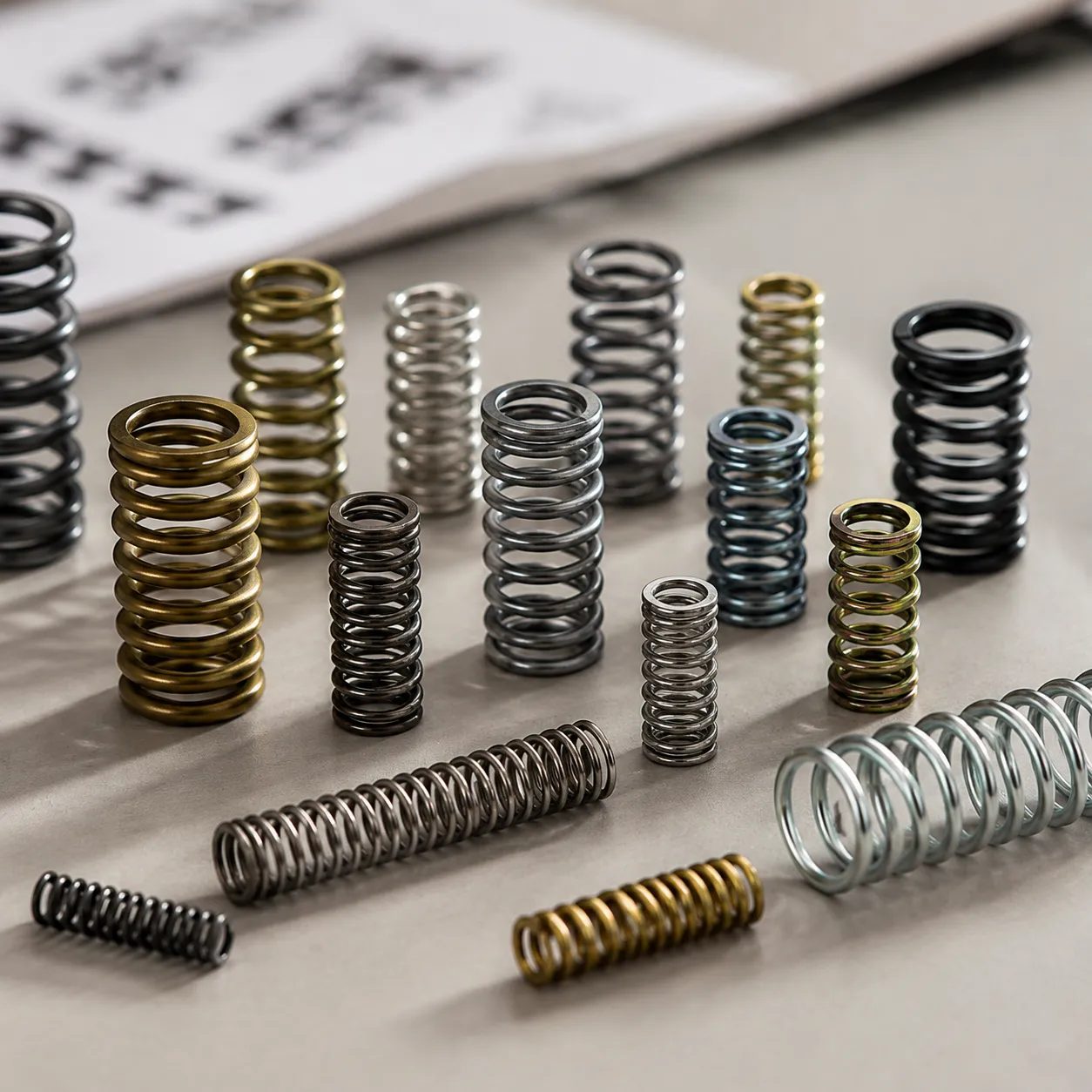
Getting the exact measurements for your compression coil spring guarantees optimal mechanical performance and long service life. As custom spring manufacturers, we evaluate these core metrics to match your application requirements. For a deeper breakdown of specs, review our compression spring guide.
Dimensions and Diameters
Accurate diameter sizing ensures the helical spring fits properly inside a bore or over a shaft without binding during operation.
| Dimension | Symbol | Definition |
|---|---|---|
| Wire Diameter | d | Thickness of the raw spring wire material. |
| Outer Diameter | OD | Maximum external width across the coils. |
| Inner Diameter | ID | Available clearance space inside the coil ring. |
| Mean Diameter | D | Average diameter (OD minus wire diameter), used for force calculations. |
Free Length and Solid Height
- Free Length: The total overall length of a spring in an unloaded, relaxed state.
- Solid Height: The height of the spring when fully compressed under load and all coils touch. Knowing how to compress a spring safely prevents bottoming out and permanent deformation.
- Max Travel: The available compression distance, calculated by subtracting solid height from free length.
Spring Rate and Coil Count
Spring rate defines the stiffness of the component—the exact force required to compress it per unit of distance. It directly governs the total load capacity and how effectively the unit stores elastic energy.
- Active Coils: The moving coils in an open coil design that absorb force under load.
- Total Coils: The active coils plus the inactive end coils used for structural support.
- Pitch: The center-to-center distance between two adjacent active coils.
Compression Spring End Configurations
The end configuration of a compression coil spring dictates how it sits against mating components and transfers force across an assembly. Choosing the correct end design prevents buckling, ensures proper load alignment, and reduces unnecessary wear on surrounding parts.
Open vs. Closed Ends
- Open Ends: The pitch remains consistent all the way to the end of the wire. This setup is simple to produce, but the spring lacks a flat seating surface, which can cause uneven force distribution during compression.
- Closed (Squared) Ends: The final coil pitch is reduced to zero so the end coil touches the adjacent active coil. This design creates a squarer plane that improves stability, keeping the helical spring centered during operation.
Ground vs. Unground Ends
- Ground Ends: The squared ends are flat-ground using precision grinding machinery to create a true 90-degree bearing surface. This process maximizes contact area, lowers solid height, and delivers uniform force distribution under heavy load capacity requirements.
- Unground Ends: The final coil remains raw without grinding. This offers a budget-friendly option for applications where exact axial alignment and maximum surface contact are not critical.
To determine which configuration matches your load requirements and structural constraints, explore our spring compression guide for types, materials, and specs or check our custom compression springs guide for engineered coil solutions.
Materials and Surface Treatments
Selecting the right raw material and finish directly dictates the fatigue life, load capacity, and environmental resistance of any compression coil spring. As a professional mechanical springs manufacturer, we engineer springs using a variety of metals and protective coatings to match specific application demands.
Standard Carbon and Alloy Steels
Carbon and alloy steels form the backbone of industrial spring manufacturing, offering high tensile strength and cost-effective performance:
- Music Wire (ASTM A228): High tensile strength and uniform toughness, ideal for high-stress applications using smaller wire diameters.
- Oil Tempered Wire (ASTM A229): Excellent general-purpose material suitable for standard machinery and repetitive compression cycles.
- Chrome Silicon & Chrome Vanadium: High-alloy steels built to withstand heavy shock loads, high stress, and elevated operational temperatures.
Stainless Steel and Specialty Alloys
For environments exposed to moisture, harsh chemicals, or extreme thermal ranges, stainless steel and exotic alloys offer superior longevity and corrosion protection:
- 302 & 304 Stainless Steel: Highly versatile options providing strong corrosion resistance and reliable mechanical performance. Review our detailed compression spring stainless guide for specific grade breakdowns.
- 316 Stainless Steel: Superior resistance to pitting and chloride environments, making it the preferred choice for marine and medical applications.
- Inconel & Hastelloy: Specialty nickel-based alloys designed for extreme temperature resistance and chemical processing equipment.
Surface Coatings and Finishes
Secondary finishes enhance resistance to wear and rust while improving overall operating life. For help identifying the best combination for your build, consult our compression spring material selection guide.
- Zinc Plating: Offers cost-effective sacrificial corrosion protection against general moisture.
- Powder Coating & E-Coating: Delivers a thick, durable barrier for severe outdoor or chemical environments.
- Passivation: Essential for stainless steel to remove surface contaminants and enhance natural oxidation resistance.
- Shot Peening: Introduces compressive residual stress on the spring surface to significantly increase fatigue strength and extend cycle life.
Common Applications of Compression Springs
As a professional mechanical springs manufacturer, we engineer compression coil springs to store elastic energy, manage force, and deliver efficient shock absorption across global industries.
Automotive and Aerospace
High-performance vehicle systems and aircraft components demand extreme reliability under high load capacity and demanding operating environments:
Suspension Systems: Absorb road impact to maintain vehicle stability, traction, and passenger comfort.
Engine Valves & Clutches: Maintain tight fluid seals and smooth gear engagement during rapid engine cycles.
Flight Controls & Interiors: Provide predictable pushback force in cockpit control linkages, seating mechanisms, and cargo doors.
Industrial Machinery and Tools
Factory automation and heavy equipment rely on precise spring rate performance to withstand continuous duty cycles:
Stamping Presses & Tooling: Use heavy-duty compression springs to buffer intense mechanical impact and return components quickly to position.
Flow Control Valves: Maintain consistent sealing pressure in hydraulic, pneumatic, and processing pipelines.
Assembly Conveyors: Regulate belt tension and dampen machine vibration during continuous operations.
Medical Devices and Consumer Electronics
Compact designs with ultra-fine wire diameter specs bring precision to small-scale mechanisms:
Medical Equipment: Power drug delivery injectors, diagnostic devices, and surgical tools with high repeatability.
Consumer Products: Deliver smooth tactile feedback in push buttons, switches, battery contacts, and door handles.
Review our detailed compression spring guide on materials and applications to match the right spring design to your operating requirements.
How to Select and Measure Compression Springs
Selecting the right compression coil spring ensures your equipment operates smoothly and reliably. As a professional mechanical springs manufacturer, we recommend verifying exact dimensions, load capacity, and operating environment before placing an order.
How to Measure Compression Spring Dimensions
Accurate measurements prevent fitment issues. Use digital calipers to record these essential dimensions:
- Wire Diameter: Measure the thickness of a single strand of wire.
- Outer Diameter (OD): Measure across the widest outer point of the open coil.
- Inner Diameter (ID): Measure the inside clearance of the spring (OD minus two times the wire diameter).
- Free Length: Measure the total uncompressed spring height when no load is applied.
- Active Coils: Count the coils that absorb load and store elastic energy, excluding inactive end coils.
Evaluating Load and Environmental Requirements
Every application demands specific load limits and resistance to environmental stress:
- Spring Rate & Load Capacity: Calculate the required force per inch or millimeter of deflection to ensure the spring reaches its target working height without taking a permanent set.
- Operating Environment: Extreme heat, moisture, or chemical exposure dictate whether standard carbon steel or corrosion-resistant stainless steel is required.
Custom vs. Standard Spring Options
Determining whether to buy off-the-shelf parts or order custom designs depends on your performance requirements:
| Feature | Standard Stock Springs | Custom Springs |
|---|---|---|
| Lead Time | Fast shipping | Built to spec |
| Cost | Low upfront cost for small quantities | Cost-effective for specialized bulk orders |
| Fit & Specs | Fixed standard sizes | Exact wire diameter, pitch, and shapes |
| Best Used For | Quick repairs, standard assemblies | OEM machinery, high-stress applications |
Review our compression spring buying tips for basic specs, or work directly with an experienced compression spring manufacturer for custom and stock springs to engineer high-precision components for your exact system requirements.

