

What is a Compression Spring?
Basic Definition and Mechanism
A compression spring is an open coiled helical component engineered to offer resistance against axially applied pressure. As a professional mechanical springs manufacturer, we design these components to efficiently store potential energy when subjected to an axial load. When force is applied to squeeze the coils together, the spring wire absorbs the load and exerts a counter-force to push back against the applied pressure, returning to its original position once released.
Key Terminology and Characteristics
Selecting or designing the correct compression spring requires an understanding of its primary physical parameters:
- Outer Diameter (OD): The overall external width of the spring's coiled body.
- Free Length: The total length of the spring in its uncompressed state with no force applied.
- Solid Height: The maximum compressed length achieved when all coils touch under load.
- Pitch: The distance measured center-to-center between adjacent active coils.
- Spring Rate: The amount of force required to compress the spring per unit of distance, indicating its stiffness.
- Load Capacity: The maximum structural force a spring can endure before reaching solid height or permanent deformation.
How Compression Springs Work
Mechanical Principles of Energy Storage
When an axial load is applied to an open coiled helical compress spring, the coils compress closer together to resist the push. As an established compression springs manufacturer, we design each spring wire structure to absorb applied force and convert it into stored potential energy.
Once the compressive force is released, the spring uses that stored potential energy to push back against the load, smoothly returning to its original free length.
Load and Deflection Performance
A spring's performance depends on how its physical dimensions translate applied force into distance moved:
- Spring Rate: The force required to compress the spring by a specific unit of distance. A constant spring rate means the resistance scales linearly with force.
- Deflection: The total distance the spring travels from its resting free length when pushed by a load.
- Solid Height: The point where every coil touches the adjacent coil, meaning the spring cannot compress any further and hits its ultimate structural boundary.
We build high-performance custom compression springs engineered to balance maximum load capacity and deflection pitch without suffering structural fatigue over extended operating cycles.
Common Types and Shapes of Compression Springs
As a leading mechanical springs manufacturer, we engineer open coiled helical components tailored to specific load profiles and mounting constraints. While standard cylindrical profiles are widespread, changing the outer diameter across the coil length creates specialized geometry options designed for distinct mechanical forces and clearance needs. Learn more about custom sizing and profiles in our compression spring shapes guide.
Conical Compression Springs
Conical springs feature a continuous taper where the outer diameter gradually decreases from bottom to top.
Reduced Solid Height: Coils nest partially or fully inside each other during compression, minimizing fully collapsed height.
Buckling Resistance: The tapered geometry prevents lateral bending, eliminating the need for guide rods.
Progressive Spring Rate: Smaller coils engage progressively as the load increases, offering variable resistance.
Hourglass Compression Springs
Hourglass springs feature a concave profile with a smaller center diameter and wider top and bottom ends.
Axial Load Alignment: The concave shape inherently centers applied forces along the primary axis.
Clearance Management: The narrow center section easily avoids surrounding housing components or obstacles.
Dynamic Stability: The geometry resists lateral movement during high-frequency operational cycles.
Barrel Compression Springs
Barrel springs are designed with a convex shape, featuring a wider center coil diameter that tapers down toward both ends.
Vibration Dampening: The varying coil diameters reduce natural frequency surge and operational resonance.
Space-Saving Design: End coils taper down to fit standard mounting surfaces while maintaining a high load capacity.
Nonlinear Load Response: Provides smooth energy absorption during initial stroke and higher resistance near solid height.
Compression Spring End Configurations
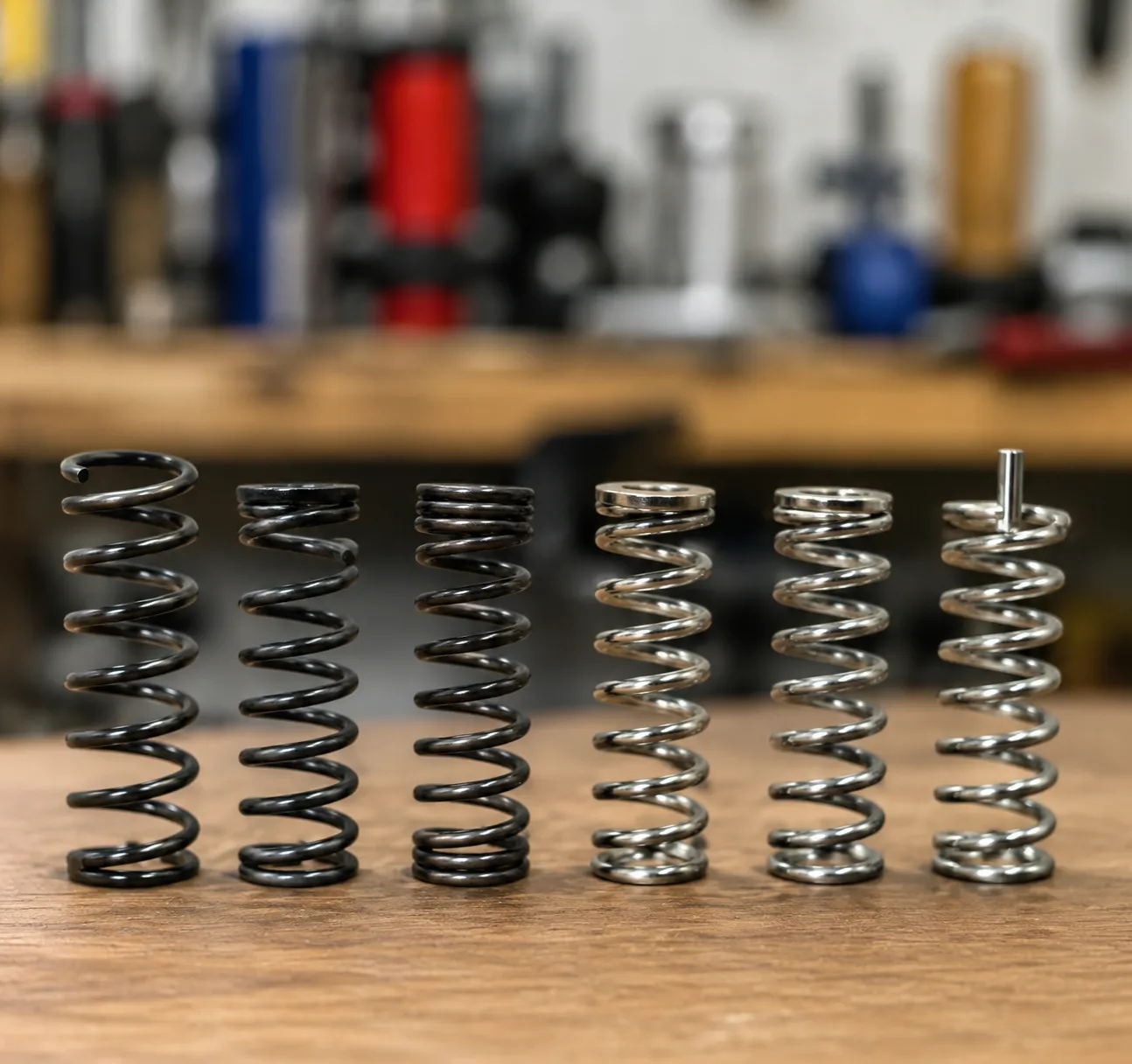
The end configuration of a compress spring dictates how it interfaces with mating components, directly impacting seating stability, solid height, and overall performance under an axial load. As a professional mechanical springs manufacturer, we tailor end styles to optimize your spring's squareness and force transfer.
Open and Closed Ends
- Open Ends: The open coiled helical pitch remains constant straight to the end of the spring wire. Open ends are cost-effective to produce, but they provide a smaller contact surface and are prone to tangling in bulk packaging.
- Closed Ends: The end coils are pressed flush against the adjacent coil, creating a flat bearing plane. Closed ends improve alignment and stability under high stress. You can explore how different end styles affect load capacity in our detailed compression spring selection guide.
Ground and Unground Ends
- Ground Ends: Mechanical grinding creates a flat, 90-degree perpendicular surface relative to the spring axis. Ground ends maximize squareness, lower the risk of buckling, and ensure consistent pressure distribution across the mating surface.
- Unground Ends: The wire retains its full round profile at the tips. Unground ends eliminate extra machining steps, making them ideal when manufacturing cost is prioritized over strict vertical alignment.
| End Configuration | Core Advantage | Best Used For |
|---|---|---|
| Open & Unground | Lowest manufacturing cost | Non-critical assemblies with low load requirements |
| Closed & Unground | Prevents tangling, cost-effective | Standard industrial equipment and enclosures |
| Closed & Ground | Maximum seating squareness & load stability | High-precision, high-speed, or severe-duty applications |
Evaluating end treatments alongside key design specifications in our spring compression technical parameters guide ensures your system operates with maximum efficiency and extended fatigue life.
Compression Spring Materials
Choosing the right material for your compress spring dictates its strength, lifespan, and overall performance under force. We manufacture custom and standard springs using premium spring wire tailored to balance load capacity, fatigue resistance, and environmental durability.
Carbon Steel and Music Wire
Carbon steel alloys remain the most common choice for heavy-duty mechanical springs due to their high tensile strength and cost-efficiency.
Music Wire (ASTM A228): The gold standard for small, high-stress coil springs. It delivers outstanding tensile strength and handles repetitive dynamic loading without taking a permanent set.
Hard-Drawn Steel (ASTM A227): A cost-effective material best suited for low-stress, static applications.
Oil-Tempered Wire: Ideal for general automotive and industrial uses requiring high fatigue resistance under cyclic loads.
Stainless Steel Alloys
When your application demands corrosion resistance or hygiene, stainless steel alloys are the default choice. To compare specific grades and thermal properties, explore our complete compression spring stainless guide.
302 / 304 Stainless Steel: Excellent general-purpose corrosion resistance with strong mechanical properties for everyday moisture exposure.
316 Stainless Steel: High nickel and molybdenum content provides superior resistance to chlorides, salt water, and harsh chemicals.
17-7 PH Stainless Steel: Offers high strength, exceptional heat resistance, and minimal deflection change under elevated operating temperatures.
Specialty Alloys and Non-Ferrous Metals
For extreme operating conditions involving high heat, magnetic sensitivity, or electrical currents, standard metals fall short. As reliable compression spring suppliers for custom sizes and materials, we engineer solutions using advanced non-ferrous options:
Inconel Alloys (Inconel 600/X-750): Built for high-temperature service and aggressive chemical processing.
Phosphor Bronze: Provides high electrical conductivity and zero magnetic interference, perfect for electronic switches and sensors.
Beryllium Copper: Combines maximum tensile strength with high thermal and electrical conductivity.
How to Measure and Calculate Compression Springs
Accurate measurements ensure your open coiled helical spring performs reliably under required operating conditions. As a trusted compression spring manufacturer for custom and stock springs, we rely on standardized physical measurements to manufacture components that fit exact assembly constraints.
Key Dimensional Parameters
To measure a compress spring correctly, use precision digital calipers and document these primary dimensions:
| Parameter | Symbol | Description | How to Measure |
|---|---|---|---|
| Wire Diameter | d | Thickness of the spring wire | Measure a single strand of wire |
| Outer Diameter | OD | Total width across the exterior coil | Measure across the widest outside edges |
| Inner Diameter | ID | Available space inside the coil | Measure the inside span from coil to coil |
| Free Length | FL | Total spring length without applied force | Measure end-to-end in an uncompressed state |
| Solid Height | SH | Total length when fully compressed | Measure height when all coils touch |
| Active Coils | Na | Working coils that flex and store potential energy | Count total coils minus non-working end coils |
Spring Rate and Load Calculations
Spring rate determines the force required to compress a spring per unit of distance. Calculating exact load capacity prevents permanent deformation and structural fatigue, particularly when working with heavy-duty compression springs.
- Spring Rate Formula: k = (G * d^4) / (8 * D^3 * Na)
- k: Spring rate (lb/in or N/mm)
- G: Shear modulus of the material
- d: Wire diameter
- D (Mean Diameter): Outer Diameter - Wire Diameter
-
Na: Active coil count
-
Axial Load Calculation: Load (P) = Spring Rate (k) * Deflection
- Deflection: Free Length - Compressed Working Height
Matching these calculated specs against your physical dimensions ensures your compress spring maintains stable force and long service life.
Applications of Compression Springs
As a professional mechanical springs manufacturer, we design open coiled helical components built to absorb axial load and store potential energy across demanding global industries.
Automotive and Transportation
Automotive systems rely on precise spring rate engineering and high load capacity to ensure vehicle safety, comfort, and performance.
- Suspension Systems: Absorb road shocks, support vehicle weight, and maintain tire contact.
- Powertrain & Transmission: Maintain proper pressure in clutch assemblies and valve trains; explore our clutch spring guide for setup and buyer insights.
- Braking Systems: Supply immediate return force to disengage brake pads and calipers.
Industrial Machinery
Heavy-duty manufacturing equipment requires durable spring wire materials that withstand high repetition without failing under stress.
- Stamping Presses: Deliver precise force and rapid return cycles in metal-forming die sets.
- Pressure Relief Valves: Hold seals firmly shut until dynamic pressure triggers accurate relief.
- Automation & Actuators: Provide reliable tension and movement control along high-speed conveyor lines.
Medical Devices and Consumer Products
Small-scale applications require tight control over outer diameter and free length parameters to fit within modern, compact enclosures.
- Medical Hardware: Power auto-injectors, fluid delivery syringes, inhalers, and surgical tools.
- Consumer Electronics & Housewares: Drive battery contacts, door locks, light switches, and ballpoint pens.
- Space-Saving Designs: In tight compartments, space-saving options like conical compression springs maximize travel while keeping solid height to a minimum.
Custom Compression Spring Design Considerations
Designing a custom compress spring requires balancing physical space, force requirements, and environmental conditions to ensure long-term durability and fatigue resistance.
Space and Operating Load Constraints
When physical dimensions are fixed, every millimeter counts. You must balance dimensional boundaries with structural capacity:
- Envelope Dimensions: Define the outer diameter and inner diameter to fit inside housings or over rods without binding.
- Deflection Limits: Verify the clearance between free length and solid height to ensure the spring reaches operating stroke without coil clash.
- Force Requirements: Calculate the necessary spring rate to deliver the target load capacity under maximum axial load.
Utilizing an online compression spring calculator allows you to model wire diameter, pitch, and total coils before prototyping. As a dedicated custom compression spring manufacturer, we partner with engineering teams to optimize these structural parameters within tight tolerances.
Environmental and Corrosion Resistance Factors
Operating environments dictate material choice and surface treatment to prevent early fatigue failure:
- Operating Temperatures: Standard carbon steel loses tension in high heat, requiring specialized spring wire alloys like Inconel or 316 Stainless Steel for extreme thermal stability.
- Corrosive Exposure: Moisture, salt spray, or harsh chemicals demand protective surface finishes such as zinc plating, passivating, or powder coating.
- Cyclic Fatigue: High-cycle applications benefit from shot peening, which relieves surface stress and extends operational lifespan under repeated deflection.


