

What Are Compression Springs and How Do They Work?
Definition and Working Principle
Compression springs are open-coil helical coils designed to resist opposing compressive forces along their axis. When an external load is applied, the spring compresses, storing potential energy within its structure. As the force is reduced or removed, the stored energy pushes back against the load to return the spring to its original free length. As a professional mechanical springs manufacturer, we engineer these components with exact wire diameter tolerances to ensure predictable linear force output and consistent mechanical performance.
Common Applications and Industry Uses
Due to their versatility, industrial springs are foundational components across global manufacturing sectors:
- Automotive: Suspension setups, valve trains, clutches, and brake assemblies.
- Aerospace & Defense: Actuators, fluid valves, and flight control systems.
- Industrial Machinery: Heavy duty stamping presses, valves, and automated equipment.
- Medical Devices: Surgical tools, diagnostic devices, and dosing syringes requiring precise metric size parameters.
- Electronics & Hardware: Electrical switches, door locks, and battery contacts.
Key Advantages of Compression Springs
- Exceptional Energy Storage: Delivers maximum resistance and energy return within compact, space-constrained assemblies.
- Predictable Cycle Life: Uniform pitch and high-fatigue materials ensure consistent performance over millions of operational cycles.
- Cost-Effective Reliability: Simple, robust mechanics keep production costs low while maintaining high operational durability.
- Material Versatility: Fabricated using premium stainless steel, carbon steel, and specialized alloys for superior environmental resilience.
Types of Compression Springs Available for Sale
We supply a wide range of helical coils engineered to deliver precise resistance across diverse industrial applications. Choosing the right compression springs for sale depends on your exact load, spatial constraints, and environmental performance requirements.
Standard and Stock Compression Springs
For quick maintenance replacements and standard mechanical assemblies, our inventory of stock springs keeps lead times minimal and costs down.
- Ready-to-Ship Availability: Pre-manufactured in standard metric size and imperial dimensions.
- Versatile Material Options: Available off-the-shelf in durable stainless steel and carbon steel.
- Cost Efficiency: Perfect for rapid prototyping, repairs, and standard production runs.
- Learn more about sourcing options through our guide to custom and stock springs.
Heavy-Duty and High-Load Compression Springs
Built to withstand extreme mechanical pressure and continuous high-stress cycling, these heavy duty industrial springs utilize high-tensile alloys and larger wire diameter specifications.
- Maximized Load Capacity: Formulated to absorb heavy force without permanent set or fatigue failure.
- Rugged Materials: Crafted from heavy-grade spring steel and specialized alloy wires.
- Target Applications: Crucial for stamping machinery, automotive suspensions, and heavy industrial equipment.
- Review our resource on heavy-duty compression springs to calculate exact load and stress requirements.
Conical and Specialty Compression Springs
Specialty profiles resolve spatial limitations and non-linear force requirements that standard cylindrical shapes cannot address.
- Conical (Tapered) Springs: Telescope inward during compression to yield a lower solid height.
- Barrel and Hourglass Springs: Provide superior lateral stability and resist buckling under load.
- Variable Pitch Designs: Deliver progressive spring rates for smooth, adaptable shock absorption.
Custom-Engineered Compression Springs
As a professional mechanical springs manufacturer, we design and produce custom springs built to your exact engineering drawings and performance criteria.
- Exact Geometry: Customized outer diameter, inner diameter, coil spacing, and free length.
- Targeted Performance: Precise load rates tailored to your exact operational thresholds.
- Specialized Materials: Precision-coiled from high-temp alloys, music wire, or specialized stainless steel grades.
Material Options and Environmental Resistance
Choosing the right alloy for your compression springs for sale determines how well your machinery performs under operational stress and harsh ambient conditions. We manufacture helical coils using proven metals tailored to exact mechanical and environmental demands.
Stainless Steel and High-Carbon Spring Steel
- Stainless Steel (302, 304, 316): Offers exceptional corrosion resistance and high tensile strength. Ideal for medical devices, marine hardware, and food processing equipment. For detailed grade breakdowns, review our stainless steel compression spring guide.
- High-Carbon Spring Steel (Music Wire, Hard Drawn): Delivers superior fatigue resistance and maximum tensile strength at a cost-effective price point. Best suited for indoor industrial springs where moisture exposure is minimal.
| Material Type | Max Operating Temp | Corrosion Resistance | Typical Application |
|---|---|---|---|
| Music Wire (ASTM A228) | 121°C / 250°F | Low | High-stress indoor mechanisms |
| Stainless Steel 302/304 | 260°C / 500°F | High | General outdoor & commercial use |
| Stainless Steel 316 | 300°C / 570°F | Excellent | Chemical processing & marine |
Corrosion-Resistant and High-Temperature Alloys
When standard metals fail under extreme heat or chemical exposure, we utilize specialized superalloys engineered for severe environments:
- Inconel Alloys (X-750, 718): Retains tensile strength and spring retention in extreme heat up to 593°C (1100°F).
- Monel & Hastelloy: Provides specialized protection against harsh acids, salt water, and aggressive marine environments.
- Titanium: Offers an unmatched strength-to-weight ratio with superior chemical resistance for aerospace components.
To evaluate stress limits across exotic metals, explore our complete compression spring materials guide.
Protective Coatings and Surface Finishes
Surface treatments expand environmental resistance, prevent rust on carbon steel, and boost overall spring service life.
- Zinc Plating & Galvanization: Provides sacrificial corrosion protection for budget-friendly steel components.
- Powder Coating & E-Coating: Creates a durable physical barrier against chemical exposure, salt spray, and moisture.
- Shot Peening: Blasts the wire surface to induce compressive stress, dramatically improving fatigue life under repetitive cycles.
- Passivation: Removes free iron from stainless steel surfaces to maximize natural corrosion protection.
Understanding Compression Spring End Types
The end configuration of helical coils dictates how load transfers across an assembly, directly impacting alignment, squareness, and overall service life. When evaluating compression springs for sale, selecting the right end style prevents buckling and uneven wear under load. For a deeper breakdown of coil configurations, explore our compression spring guide.
Closed and Ground Ends
- Flat Surface: Coils are closed and ground flat, creating a 90-degree perpendicular seating surface.
- High Stability: Provides the most square force distribution and minimizes lateral deflection.
- Best Uses: Precision machinery, high-speed actuators, and heavy duty industrial springs.
Closed and Unground Ends
- Economical: End coils are pressed flush against adjacent coils, but the wire tips remain unground.
- Balanced Design: Delivers adequate squareness for standard mounting without the added cost of surface grinding.
- Best Uses: General hardware, commercial assemblies, and budget-conscious stock springs applications.
Open and Unground Ends
- Continuous Pitch: Coils maintain a consistent space all the way to the very tip of the wire.
- Threaded Mounting: Allows the spring to thread onto shafts or fit into specialized bore guides.
- Best Uses: Low-load mechanisms, short-travel components, and specialized custom springs requiring unique end fitting.
How to Measure Compression Springs Before Buying
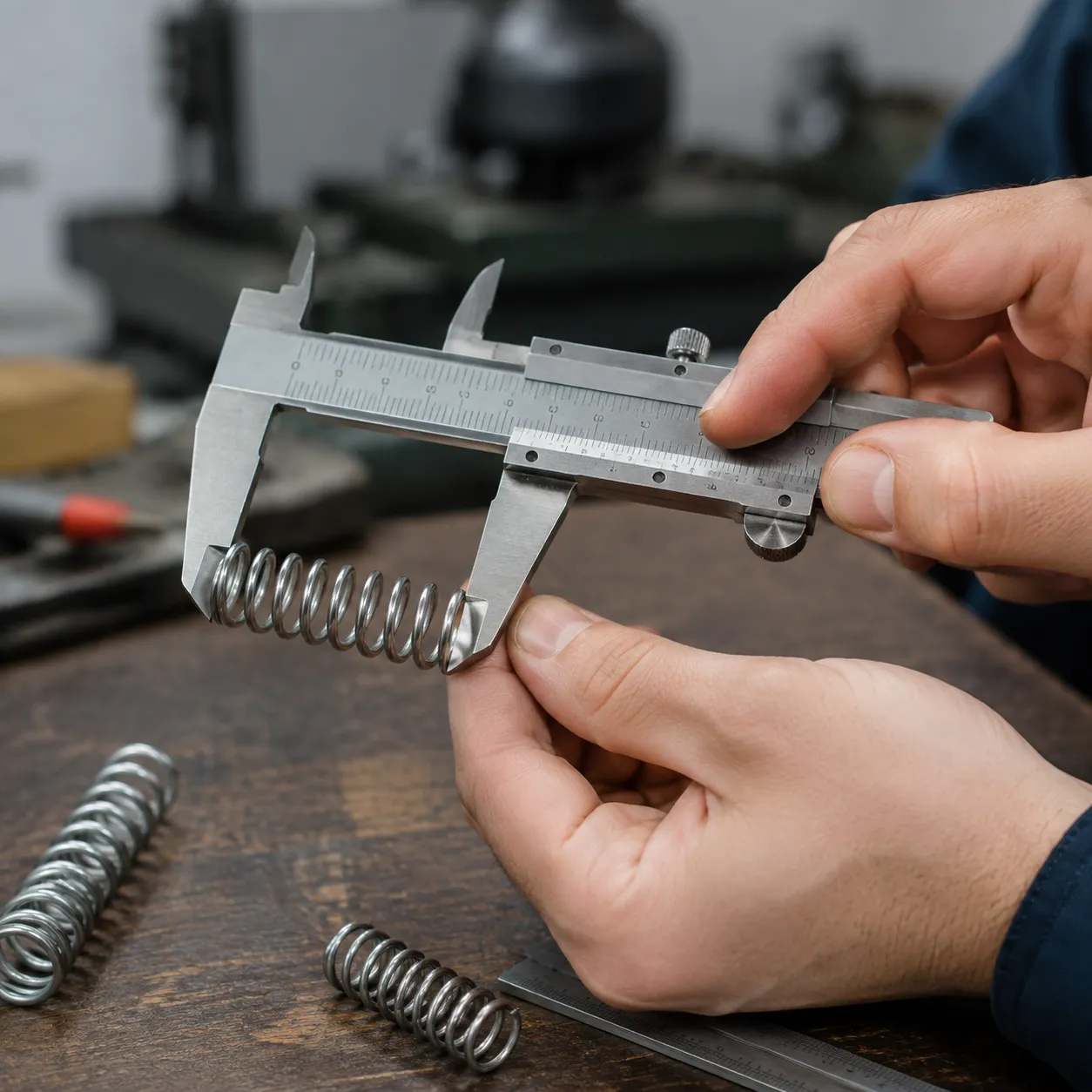
Getting accurate dimensions before browsing compression springs for sale ensures your mechanical components fit and function without binding or premature failure. We recommend using digital calipers for exact measurements across all key parameters.
Outer Diameter and Inner Diameter
- Outer Diameter (OD): Measure across the outermost edges of the helical coils. This is critical when the spring needs to fit inside a housing, bore, or tube.
- Inner Diameter (ID): Measure the distance across the inside opening of the coil. This metric is essential if your spring operates over a shaft, rod, or mandrel.
- Clearance Tip: Always account for coil expansion under load—the OD increases slightly as the spring compresses.
Wire Diameter and Free Length
- Wire Diameter (WD): Measure the precise thickness of the spring wire. Small variations in wire diameter dramatically alter the overall load capacity and spring rate.
- Free Length (FL): Measure the overall length of the spring in its uncompressed, relaxed state from end to end.
If your application requires non-standard tolerances or unique wire gauges, working with qualified compression spring suppliers for custom sizes and materials guarantees precise alignment with your design requirements.
Total Coils and Solid Height
| Measurement Parameter | Definition | How to Calculate / Measure |
|---|---|---|
| Total Coils (TC) | The total number of spiral loops from tip to tip. | Count all full revolutions plus any fractional end coils. |
| Active Coils (AC) | Coils that compress under load and store energy. | Subtract non-working end coils from total coils (typically TC - 2 for closed ends). |
| Solid Height (SH) | Maximum compressed length when all coils touch. | Multiply wire diameter by the number of total coils for ground ends. |
Selection Guide: Choosing the Right Compression Spring
Selecting the ideal compression springs for sale requires evaluating technical requirements against budget and production timelines.
Calculating Load and Deflection Requirements
Finding the proper spring starts with precise mechanics. Calculating the force required at a specific compressed height ensures your helical coils perform reliably without premature fatigue.
- Load: The total force exerted on the spring when compressed.
- Deflection: The distance traveled from free length to compressed height.
- Spring Rate: The force required per unit of travel, calculated by dividing load by deflection.
Check our spring compression formula guide for spring design to calculate exact spring rate metrics before placing an order.
Stock vs. Custom Compression Spring Sourcing
We are a professional mechanical springs manufacturer providing both ready-to-ship stock springs and custom springs tailored for specialized applications.
| Parameter | Stock Compression Springs | Custom Compression Springs |
|---|---|---|
| Lead Time | Immediate dispatch | Fast-turnaround custom production |
| Sizing | Standard metric size & imperial options | Precise wire diameter & outer diameter |
| Materials | Carbon steel & stainless steel | Specialty alloys & custom coatings |
| Best For | Quick repairs & standard equipment | Unique heavy duty industrial equipment |
Consult our compression springs by size guide for perfect fit to see if standard dimensions match your current specs.
Bulk Ordering and Quantity Considerations
Scaling your order directly impacts unit economics and supply chain stability for high-performance industrial springs.
- Tiered Pricing: High-volume production runs significantly lower unit costs.
- Scheduled Deliveries: Blanket purchase orders ensure continuous inventory supply without warehouse storage strain.
- Batch Consistency: CNC manufacturing guarantees tight performance tolerances across every production lot.


