

Overview of Spring Types and Their Applications
Understanding how springs are manufactured begins with recognizing the distinct mechanical spring types that power global industries. Mechanical springs are engineered elastic components designed to store, absorb, and release mechanical energy upon demand. As a professional mechanical springs manufacturer and supplier, we engineer these vital components across diverse geometries to meet demanding load, deflection, and environmental requirements across automotive, medical, aerospace, and industrial machinery sectors.
Compression Springs
Compression springs are open-coil helical designs built to resist axially applied compressive forces. When subjected to a load, the coils compress, storing energy that returns the mechanism to its resting position once released.
- Primary Function: Absorb shock, resist direct push force, and maintain contact pressure between components.
- Common End Configurations: Closed and ground, closed and unground, open ends, or squared ends.
- Key Industrial Applications:
- Automotive suspensions and engine valve trains
- Medical delivery devices, inhalers, and surgical tools
- Heavy stamping presses and industrial actuation valves
- Consumer electronics and electrical switchgear
Extension Springs
Extension springs operate in reverse to compression designs. Manufactured with tightly wound coils that touch in their resting state, they store potential energy by resisting pulling or stretching forces along their central axis.
- Primary Function: Provide tensile resistance and return dynamic loads to an anchor point.
- Attachment Types: Machine hooks, extended loops, cross-over centers, side hooks, and custom threaded inserts.
- Key Industrial Applications:
- Overhead garage door counterbalance assemblies
- Commercial agricultural equipment and combine attachments
- Aerospace interior latches and cargo restraint mechanisms
- Heavy-duty trampolines and industrial tensioners
Torsion Springs
Torsion springs are helical springs designed to exert torque or rotational energy. Rather than compressing or extending, the wire coils twist around their central axis, exerting a mechanical force proportional to the angle of rotation.
- Primary Function: Deliver angular resistance and high torque over short or wide rotation profiles.
- Leg Configurations: Axial, radial, short hook, or custom bent legs configured to secure against opposing surfaces.
- Key Industrial Applications:
- Automotive door handles, tailgate hinges, and sun visors
- Precision balance mechanisms in medical apparatus
- Heavy-duty industrial roll-up doors and loading dock plates
- Safety switches, clothespins, and mechanical clip assemblies
Raw Materials Used in Spring Manufacturing
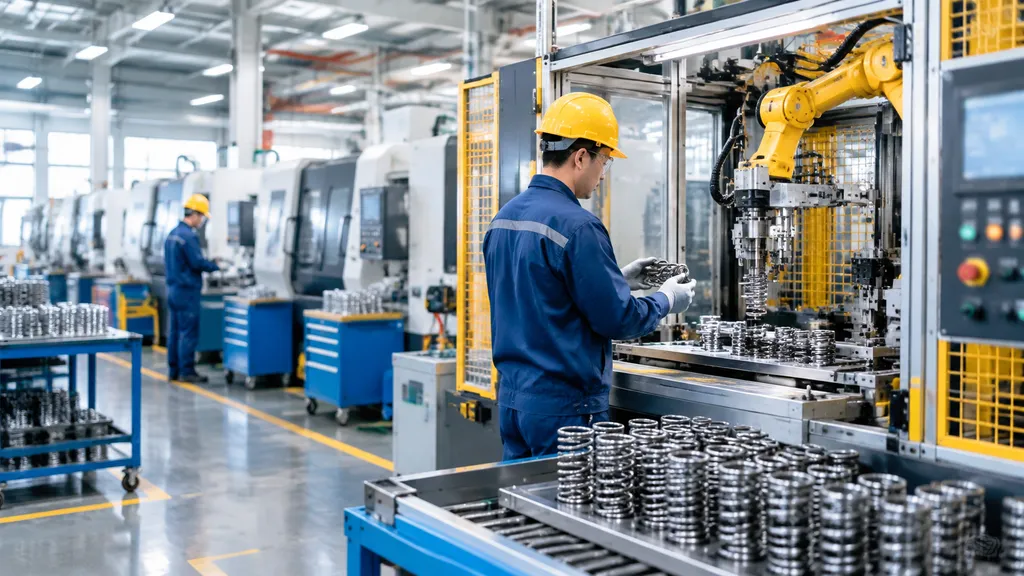
Understanding how springs are manufactured starts with the raw wire stock. The choice of metal dictates everything: cycle life, tensile strength, resistance to heat, and how the spring responds under repeated cyclic loads. We select wire grades precisely to prevent premature fatigue and deformation in demanding mechanical systems.
High-Carbon and Alloy Steels
High-carbon and alloy steels are the backbone of industrial spring fabrication, offering unmatched tensile strength at a cost-effective price point:
- Music Wire (ASTM A228): High-tensile, uniform carbon steel wire ideal for high-stress applications with repeated cycles.
- Hard Drawn Steel (ASTM A227): Cost-efficient commercial wire used for low-stress, static load applications.
- Oil-Tempered Wire: Pre-heat-treated general-purpose wire often coiled into large suspension and machinery components.
- Chrome Silicon & Chrome Vanadium: High-grade alloy steels engineered to endure intense shock loads and elevated operating temperatures.
Stainless Steel Alloys
When operating environments involve moisture, chemicals, or sub-zero temperatures, standard carbon steels quickly fail. Stainless steel alloys provide essential corrosion resistance and maintain tensile integrity without requiring heavy surface plating.
We regularly fabricate durable stainless steel compression springs using Grade 302 and Grade 304 wire for consumer goods, medical devices, and food-processing equipment. For marine exposure or acid-rich settings, Grade 316 provides superior pitting resistance, while precipitation-hardened 17-7 PH stainless steel delivers exceptionally high strength approaching that of carbon alloys.
Non-Ferrous and High-Temperature Alloys
Severe operating conditions—such as extreme heat, electrical conductivity requirements, or magnetic interference—demand non-ferrous and specialty nickel alloys:
- Phosphor Bronze & Beryllium Copper: Excellent electrical conductivity, non-magnetic properties, and high fatigue limits for switchgear, electronics, and precision instrumentation.
- Inconel Alloys (X-750, 718): Nickel-chromium superalloys built to withstand extreme temperatures exceeding 1,000°F (537°C) without losing elastic temper, commonly deployed in aerospace, turbine, and nuclear valve assemblies.
- Hastelloy & Monel: Highly specialized metals chosen for aggressive chemical processing and severe offshore marine environments where pitting and stress corrosion cracking are constant threats.
Spring Coiling Techniques: Cold Winding vs. Hot Winding
When examining how springs are manufactured, the primary shaping phase comes down to two foundational methods: cold winding and hot coiling. The route we choose depends almost entirely on the wire diameter, the raw material grade, and the required load capacity of the finished component. As a professional mechanical springs manufacturer and supplier, we deploy both techniques on our production floor to balance dimensional precision with structural strength.
| Feature | Cold Winding | Hot Winding (Hot Coiling) |
|---|---|---|
| Typical Wire Diameter | Up to 0.625 in (16 mm) | Over 0.625 in (16 mm) up to 3+ in (75 mm) |
| Material State | Pre-hardened wire at room temperature | Annealed steel heated to ~1700°F (925°C) |
| Machinery Used | Automated CNC coiling machine | Heavy-duty rotating mandrels and furnaces |
| Primary Advantage | High speed, tight tolerances, fine finish | Extreme load capacity, no cracking in thick stock |
| Typical Post-Processing | Low-temperature stress relief | Full quench-and-temper heat treatment |
Cold Winding for Small to Medium Springs
Cold winding handles the bulk of commercial spring production, covering everything from delicate precision electronics to standard automotive components. In this process, the wire feeds through guide rollers at room temperature directly into an automated CNC coiling machine.
- High-Speed Precision: Computerized tooling deflects the wire against custom coiling points to create open or closed coils, variable pitches, and custom end configurations on the fly.
- Pre-Hardened Materials: We run pre-tempered, high-tensile wire (such as music wire, hard-drawn carbon steel, or stainless steel) that already possesses its baseline spring properties before shaping.
- Minimal Thermal Distortion: Because the metal stays cold, parts maintain exceptionally tight outer-diameter and free-length tolerances. This makes cold coiling the preferred method when producing standard industrial components, such as high-run compression springs with various end configurations.
- Stress Relieving: After coiling, these springs move straight to an inline oven for a low-temperature heat treatment cycle to relieve residual bending stresses without altering the core hardness.
Hot Winding for Heavy-Duty Springs
When wire stock exceeds 16 mm (5/8 inch) in diameter, coiling it cold can introduce micro-cracks, overstress tooling, and cause severe work hardening. For oversized requirements—such as freight rail suspensions, mining machinery, and heavy-duty industrial springs—we shift to hot winding.
- Thermal Softening: Unhardened steel bars enter an industrial furnace and heat to red-hot temperatures, typically around 1600°F to 1750°F (870°C to 950°C). Heating increases the steel's ductility so thick bars bend smoothly around a powered mandrel without snapping.
- Mandrel Forming: The heated bar spools mechanically around an arbor that dictates the inner diameter and pitch.
- Immediate Quenching and Tempering: Right after leaving the winding mandrel, the red-hot spring drops directly into an oil or polymer quench tank. This rapid cooling creates a hard martensitic grain structure.
- Secondary Tempering: The quenched spring is extremely hard and brittle. We immediately reheat it in a tempering furnace at controlled temperatures to restore ductility, yield strength, and toughness. Hot coiling guarantees that even the heaviest suspension units can withstand millions of violent shock cycles without catastrophic failure.
The Step-by-Step Spring Manufacturing Process
Understanding how are springs manufactured requires a close look at precision engineering, automated machinery, and thermal treatment. As a professional mechanical springs manufacturer and supplier, we follow a strict sequence of steps to transform raw round or flat wire into high-performance components built to handle millions of operating cycles.
Step 1: Coiling and Wire Forming
Every spring begins with wire feeding and forming. We load high-tensile wire into an advanced CNC coiling machine, which pulls the stock through straightening rollers before pushing it against specialized coiling pins and pitch tools.
- Setup and Pitch Control: The tooling guides the wire to establish the exact outer diameter (OD), inner diameter (ID), and pitch spacing.
- Forming Complex Geometries: For compression springs, the machine shapes uniform or variable coil pitches. For extension and torsion designs, automated wire formers bend precise end hooks, loops, or straight legs directly off the arbor.
- Automated Shearing: Once the coil reaches its target length, a synchronized cutter shears the wire, preparing the spring for thermal processing.
Engineers align these parameters with standard calculations like the spring compression equation guide for design and testing to ensure every coiled blank matches its planned mechanical characteristics.
Step 2: Heat Treating and Stress Relieving
The coiling process introduces significant residual stress into the wire matrix. Without prompt thermal treatment, springs deform, lose load capacity, or snap prematurely under working loads.
We run freshly coiled batches through continuous conveyor ovens or batch furnaces for heat treatment. Typical stress-relieving temperatures range between 450°F and 900°F (230°C to 480°C), depending on whether we use music wire, stainless steel, or oil-tempered alloy wire. This heating phase reorganizes the crystal structure of the metal, locking in the physical dimensions while restoring the spring's natural elastic memory.
| Processing Stage | Target Temperature Range | Primary Objective |
|---|---|---|
| High-Carbon Steels | 475°F – 525°F (245°C – 275°C) | Relieves cold-winding mechanical strain |
| Stainless 302/316 | 600°F – 750°F (315°C – 400°C) | Eliminates shear stress without losing temper |
| Hardened Alloys | 750°F – 900°F (400°C – 480°C) | Balances yield strength and core ductility |
Step 3: End Grinding and Squaring
Compression springs often require flat, squared bearing surfaces so they sit flush against matching hardware and transmit force along a straight axis.
- Double-Disc Surface Grinding: We clamp the springs into rotating carrier plates that pass between horizontal or vertical abrasive wheels, grinding both ends simultaneously.
- Squaring Standards: The goal is to produce ends that are perpendicular to the spring axis within 1 to 3 degrees, which prevents load buckling.
- Defect Prevention: Wet cooling or timed passes keep the wire from overheating during grinding, avoiding localized annealing at the tips.
Step 4: Shot Peening for Fatigue Resistance
Dynamic applications—such as automotive valves, suspension units, and industrial actuators—demand maximum fatigue resistance. After grinding, we subject the springs to shot peening.
During this stage, high-velocity streams of round steel or ceramic shot bombard the spring wire inside a tumbling blast chamber. Each impact creates a tiny indentation on the metal surface, generating a beneficial layer of compressive residual stress. This compressive layer offsets tensile stresses encountered during operation, preventing microscopic surface cracks from forming and significantly extending working service life. Accurate calculations from our compressed spring formula guide for rate and force ensure that these post-forming treatments produce springs that deliver precise, repeatable load profiles.
Finishing and Surface Treatment for Springs
Understanding how are springs manufactured goes beyond initial forming; finishing operations dictate whether a component survives harsh operating environments or fails prematurely. As a professional mechanical springs manufacturer and supplier, we implement precise post-forming treatments to stabilize dimensions, eliminate residual stress, and shield the metal from corrosive elements.
Spring Setting and Pre-Stressing
Spring setting—also referred to as presetting or scragging—is a critical stabilization process. During this stage, we compress the spring to its solid height or stretch it beyond its normal operating yield point multiple times.
- Eliminates Length Loss: It induces intentional plastic deformation, ensuring the spring will not take a permanent set or lose free length during regular operation.
- Boosts Load Limits: Presetting introduces favorable residual stresses, effectively raising the torsional yield strength of the wire.
- Ensures Consistent Rate: Repeated cycling locks in final tolerances, which is standard practice when building high-performance units outlined in our custom compression springs guide.
| Process Type | Primary Benefit | Standard Application |
|---|---|---|
| Cold Setting | Locks in free length at room temperature | Standard automotive and industrial valves |
| Hot Setting | Minimizes relaxation under elevated temperatures | Engine valve springs and high-heat actuators |
Protective Plating and Powder Coating
Bare steel rapidly deteriorates when exposed to moisture, chemicals, or abrasive debris. We apply tailored surface finishes depending on operating conditions and cyclic requirements:
- Electroplating (Zinc and Nickel): Provides sacrificial cathodic protection against atmospheric corrosion. Zinc plating with clear, yellow, or black chromate passivations balances cost-efficiency and rust resistance. To prevent hydrogen embrittlement after plating, we bake carbon steel springs in a de-embrittlement oven immediately.
- Phosphate and Oil: Often used as an undercoat or an economical indoor barrier, providing mild corrosion resistance and aiding oil retention.
- Powder Coating and E-Coating: Ideal for heavy-duty suspension coils and outdoor machinery. Epoxy and polyester powders offer thick, impact-resistant protection against chipping, road salts, and harsh UV exposure.
- Black Oxide: Adds a thin protective film that reduces light glare and holds rust-preventative oils without changing outer component dimensions.
Carefully matching the finishing technique with the right base metal guarantees that the spring retains its exact load dynamics and designed fatigue life throughout its entire operational cycle.
Quality Control and Testing in Spring Fabrication
Understanding how are springs manufactured to exact tolerances means looking closely at the inspection floor. As a professional mechanical springs manufacturer and supplier, we never ship parts based on assumptions. Every batch undergoes rigorous quality control to guarantee that each component handles its intended operating load without premature failure.
Dimensional and Load Capacity Testing
Precision geometry is critical for proper fit and function in any assembly. We verify every critical parameter using automated optical comparators, digital micrometers, and coordinate measuring machines (CMM).
Key dimensional checks include:
Free Length and Pitch: Confirming the uncompressed length and the spacing between active coils.
Outer (OD) and Inner (ID) Diameters: Ensuring adequate clearance inside bores or over guide rods.
Squareness and Parallelism: Checking ground ends to prevent uneven side loads.
Once dimensions pass inspection, the components undergo automated spring testers to evaluate force response. We compress or extend the part to specified operational heights and record the counter-force. Comparing these metrics against our detailed compression coil spring guide ensures the spring rate (k-factor) matches exact engineering specifications.
| Test Parameter | Inspection Tool | Purpose |
|---|---|---|
| Diameter & Pitch | Vision Systems / Calipers | Guarantees proper mechanical fit in the assembly |
| Load at Height | Digital Force Gauges | Verifies correct spring rate under real loads |
| Squareness | Precision Granite Squares | Prevents buckling and unwanted friction |
Tensile Strength and Fatigue Life Testing
Springs rarely fail from a single static load; they fail from cyclic fatigue. To prevent in-field breakdowns, we run destructive and non-destructive mechanical tests on sample batches before sign-off.
- High-Speed Cycle Testing: We place sample springs into high-frequency cycling rigs, running them through hundreds of thousands—or millions—of compressions to simulate full lifecycle stress.
- Tensile and Torsional Yield Testing: We pull raw wire and formed springs to their breaking points to establish ultimate tensile strength and permanent set thresholds.
- Non-Destructive Flaw Detection: Critical components undergo magnetic particle inspection or dye penetrant testing to catch surface micro-cracks before products leave the production floor.
Key Considerations for Custom Spring Manufacturing
Understanding how springs are manufactured for custom applications requires balancing strict engineering tolerances with operating realities. Every coil profile, wire diameter, and heat treatment cycle must align precisely with the final assembly requirements. As a professional mechanical springs manufacturer and supplier, we guide clients through these critical design decisions to prevent early fatigue, permanent set, and costly mechanical failure.
Design Specifications and Load Requirements
Before setup begins on a CNC coiling machine, clear physical and mechanical boundaries must be calculated. Load and deflection dictate nearly every step of the process.
- Dimensional Boundaries: Outer diameter (OD), inner diameter (ID), free length, and solid height must fit within your application's physical cavity without binding.
- Spring Rate and Load Capacity: Determining the exact force required at working height prevents under-performance or premature yielding.
- Travel and Deflection Limits: Excessive compression or extension beyond the elastic limit causes permanent deformation, demanding precise pitch and active coil calculations.
| Design Parameter | Engineering Impact | Manufacturing Consideration |
|---|---|---|
| Wire Diameter | Controls spring stiffness and load capacity | Dictates tooling setup and machine tonnage |
| Active Coils | Directly affects deflection rate and stress | Requires precise pitch control during coiling |
| Total Travel | Determines operating stress levels | Requires pre-stressing and setting procedures |
| End Configuration | Impacts load alignment and squaring | Requires dedicated grinding or loop forming |
For specialized assemblies, partnering with reliable compression spring suppliers for custom sizes and materials ensures that tight dimensional tolerances translate seamlessly to production runs.
Environmental Conditions and Material Selection
A spring's operating environment dictates wire selection and post-forming surface treatments long before the wire enters production. Review our comprehensive compression spring types and selection guide to evaluate standard alloys versus specialty configurations.
- Temperature Extremes: Standard music wire and oil-tempered alloys lose tensile strength at elevated temperatures, requiring nickel-based superalloys like Inconel for extreme heat, or specialized stainless steels for cryogenic environments.
- Corrosive Exposure: Moisture, chemicals, and salt spray degrade base metals rapidly. Stainless steel grades (302, 316) or protective finishes like zinc plating, nickel plating, and passivated coatings stop galvanic corrosion and chemical breakdown.
- Dynamic vs. Static Cycles: High-frequency cycling applications require premium valve-grade wires and secondary shot peening to maximize fatigue limits and stop micro-crack formation.
Related Sources
- https://www.asbg.com/products-services/springs/
- https://www.newcombspring.com/resources/spring-manufacturing-process
- https://www.machinedesign.com/materials/article/21831862/fundamentals-of-spring-design
- https://www.acxesspring.com/spring-education.html
- https://www.thomasnet.com/articles/custom-manufacturing-fabricating/how-springs-are-made/


