

What Is a Spring and How Does It Work?
Understanding how does a spring work starts with the physics of elasticity and precision manufacturing. At its core, a spring operates by temporarily altering its structure under an applied load, absorbing the input work, and releasing it when required. As a professional mechanical springs manufacturer and supplier, we build these critical components to deliver repeatable, predictable mechanical response across demanding industrial environments.
Definition of a Spring
A spring is an engineered, highly elastic mechanical component designed to undergo controlled elastic deformation when subjected to an external load. Rather than resisting force with rigid immobility, a spring deflects, accommodating movement while maintaining mechanical equilibrium.
Key attributes include:
High Elastic Limit: Capability to deflect significantly without experiencing permanent, plastic deformation.
Dimensional Recovery: Immediate return to original free length and geometry once the load is removed.
Predictable Deflection Rate: Consistent relationship between the applied load and resulting displacement.
The Core Mechanism: Energy Storage and Release
The operating cycle of any spring relies on converting and transferring mechanical energy through its internal structure. When an operating load shifts the spring from its resting state, the energy cycle functions in four distinct stages:
- Load Application: An external mechanical force—compressive, tensile, or rotational—acts upon the spring wire.
- Energy Accumulation: The applied mechanical energy transforms into stored elastic potential energy as the material’s crystal lattice undergoes controlled atomic displacement.
- Restoring Force Generation: The displaced material generates an internal restoring force that acts directly against the applied load, attempting to drive the component back to its neutral geometry.
- Energy Release: As the external force recedes, the stored potential energy converts back into kinetic energy or controlled mechanical resistance, returning the spring to its original dimensions without loss of structural integrity.
The Science Behind Springs: Hooke’s Law
To understand how a spring works under load, we have to look at the physics governing its motion. As a professional mechanical springs manufacturer and supplier, our engineering processes rely directly on Hooke’s law to guarantee predictable, repeatable movement in every component we build.
Understanding Hooke’s Law
Hooke’s law states that the force needed to extend or compress a spring is directly proportional to the distance it is displaced, as long as the material stays within its elastic limit. When you apply an external load, the spring resists the motion by generating an opposing restoring force to return to its original position.
Mathematically, this relationship is expressed as:
F = -kx
- F (Restoring Force): The counter-force exerted by the spring.
- k (Spring Constant / Spring Rate): The measure of the spring's stiffness, determined by material type, wire diameter, and coil design.
- x (Displacement): The distance the spring is compressed or extended from its resting length.
As long as the spring undergoes purely elastic deformation, it will snap back cleanly once the load is removed. Exceeding this threshold causes permanent, plastic deformation, ruining the part's functionality. For a deeper technical breakdown of these variables, review our guide on the compression of a spring equation.
Calculating Spring Energy
When an applied force deforms a spring, mechanical energy converts into stored elastic potential energy. Once released, this stored potential rapidly transforms back into kinetic energy to push, pull, or rotate a mechanism back to its starting state.
The elastic potential energy stored in a deflected spring is calculated with:
PE = 0.5 × k × x²
- PE: Elastic potential energy (measured in Joules).
- k: Spring rate (stiffness).
- x: Distance compressed or stretched.
Because displacement is squared in this relationship, doubling the travel distance quadruples the energy stored inside the material. Accurately sizing components using the formula for the energy of a compressed spring prevents premature metal fatigue and ensures reliable performance under continuous industrial cycles.
Common Types of Springs
We are a professional mechanical springs manufacturer and supplier, and we engineer each spring type to control mechanical energy based on specific directional forces. While every design stores and releases energy through elastic deformation, the geometry of the wire determines exactly how it manages load in real-world equipment.
Compression Springs
Compression springs are open-coil designs built to resist applied compressive pressure. When a downward or axial push load is applied, the coils squeeze closer together, absorbing the load and storing it as elastic potential energy.
- Load Direction: Axial compression (push force).
- Operating Mechanism: The spaces between the open coil springs narrow under load, producing an immediate restoring force that pushes back to its original free length.
- Typical Applications: Automotive suspensions, valve assemblies, switches, and industrial stamping tools.
Working with established manufacturing standards outlined in our compression springs guide, we form these components from high-grade alloy or carbon steel wire to ensure repeatable fatigue life under severe cycling.
Extension Springs
Extension springs operate in reverse compared to compression units. Designed with closely wound coils that touch at rest, they absorb mechanical energy by resisting tensile pulling forces across their centerline.
- Load Direction: Axial tension (pull force).
- Operating Mechanism: End hooks or loops secure the spring between two components. As external force pulls these points apart, the coils stretch, creating tension that works to bring the parts back together.
- Typical Applications: Garage doors, medical mechanisms, industrial levers, and balance systems.
Design factors like initial tension and hook durability play a massive role in performance, as covered in our comprehensive extension springs guide.
Torsion Springs
Torsion springs work through angular torque rather than a straight push or pull. The body consists of tightly wound coils with projecting legs that attach to independent components.
- Load Direction: Radial torque (rotational force).
- Operating Mechanism: When force rotates the legs, the spring winds tighter or unwinds, decreasing or increasing the inner coil diameter while accumulating rotational energy.
- Typical Applications: Door hinges, automotive tailgates, clipboards, and heavy-duty industrial clutches.
Constant Force Springs
Constant force springs consist of tightly rolled strips of pre-stressed spring steel ribbon rather than round coiled wire. Unlike traditional springs that follow standard force curves where resistance spikes with travel distance, these springs deliver a virtually uniform load throughout their deflection stroke.
- Load Direction: Smooth linear extension.
- Operating Mechanism: As the flat strip uncoils from its natural resting radius, the section undergoing deformation resists the pull with an invariant, uniform counter-resistance.
- Typical Applications: Cable retractors, counterbalances, tape measures, and hospital equipment adjustments.
Material Science and Spring Performance
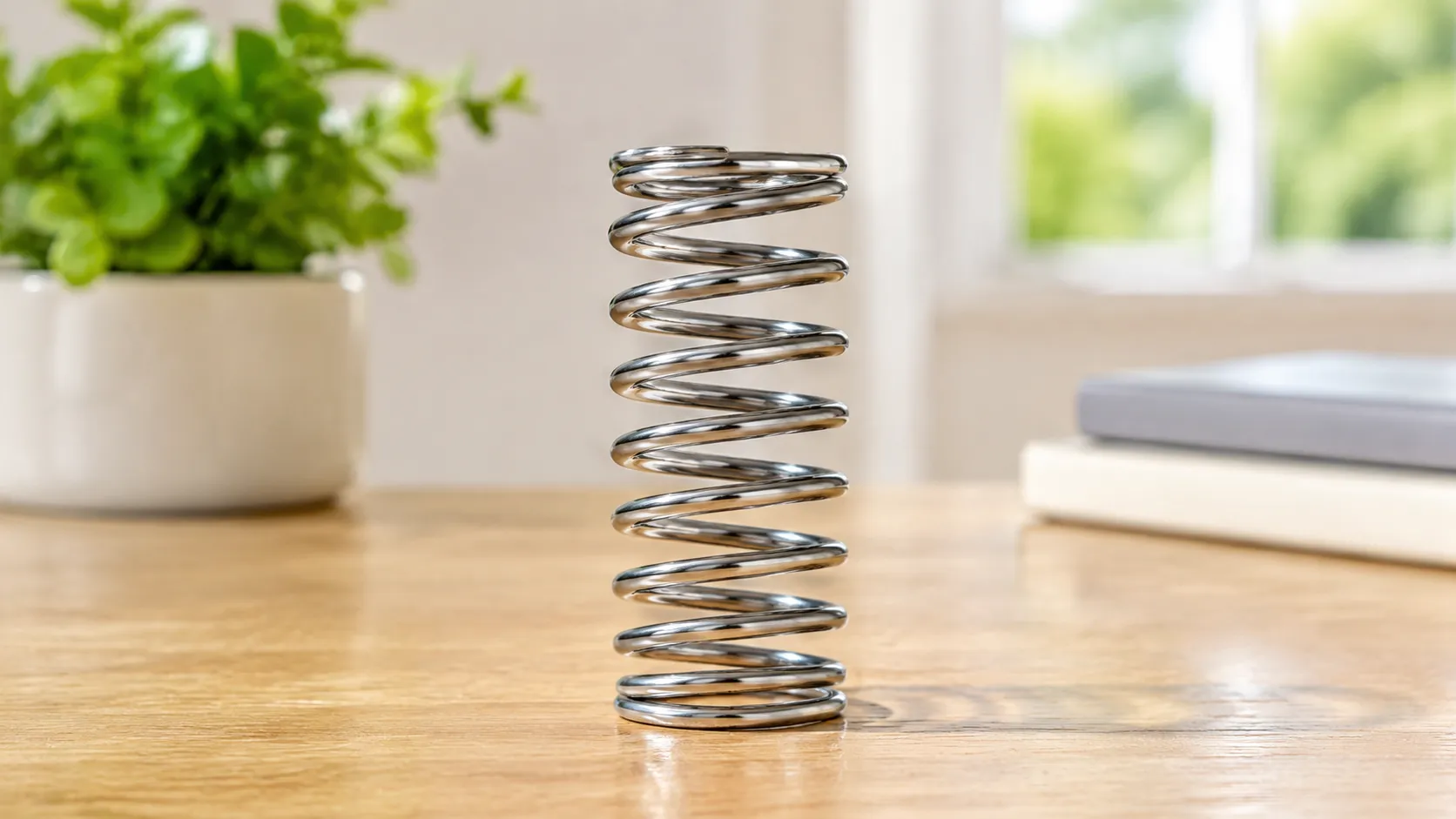
To understand how does a spring work over millions of cycles, you have to look at the metal itself. A spring relies entirely on elastic deformation to absorb mechanical energy and snap back without taking a permanent set. The wrong wire grade leads to premature fatigue, loss of restoring force, and sudden component failure.
Through precision engineering and custom spring manufacturing, we carefully select and process alloy wires to ensure optimal operational life under repetitive stress.
Selecting the Right Spring Materials
As a professional mechanical springs manufacturer and supplier, we manufacture custom springs using dedicated wire grades tailored to specific operating environments:
- Carbon Steel: Offers high tensile strength and cost-effective performance, making it ideal for standard mechanical loads and cyclic stress.
- Stainless Steel: Delivers exceptional resistance to moisture, chemicals, and elevated temperatures. It is widely specified for medical, marine, and electronic assemblies.
- Specialized Alloys: Engineered for extreme operating conditions, providing superior resistance to thermal degradation, heavy corrosion, and high fatigue loads.
For a deeper look into selecting the right metal for your design, refer to our comprehensive compression spring guide on types, materials, and uses.
Impact of Materials on Durability
Material properties directly govern how a spring manages stress and prevents permanent deformation. Even the highest-grade wire requires precise processing to perform reliably under continuous deflection:
| Manufacturing Phase | Role in Spring Durability |
|---|---|
| CNC Coiling & Forming | Advanced CNC machinery maintains uniform pitch, coil diameter, and wire alignment, eliminating micro-defects that trigger stress cracks. |
| Heat Treatment | Stress-relieving heat cycles stabilize the crystalline structure of the wire after coiling, securing the spring’s dimensional stability and elastic limits. |
| Surface Finishing | Specialized coatings and platings shield the substrate from corrosive elements, reduce friction, and enhance overall fatigue life. |
Every phase of our production operates under strict ISO 9001:2015 quality management standards, ensuring your custom springs maintain their precise spring rate and mechanical integrity throughout their intended service life.
Practical Applications of Springs
Understanding how a spring works under load is essential for designing dependable mechanical assemblies. Across modern manufacturing, springs control movement, absorb impacts, and deliver consistent restoring force. We engineer custom spring solutions to ensure that mechanical energy is absorbed and released with repeatable precision, even in high-stress operational conditions.
Automotive and Industrial Uses
Heavy-duty applications require components that endure millions of cycles without losing their elastic limits or structural integrity.
- Vehicle Powertrains and Suspensions: From engine valve controls to suspension dampeners, coil springs absorb road shocks and regulate fluid pressure under harsh thermal conditions.
- Industrial Machinery and Tooling: Stamping dies, conveyors, and automated production systems depend on high-load resistance. Engineers often refer to our custom compression springs guide to select the right wire configurations and load ratings for intensive plant environments.
- Actuators and Braking Systems: Torsion and extension springs provide immediate fail-safe return mechanisms to guarantee operator and equipment safety.
Consumer Electronics and Medical Devices
Miniaturized systems rely on tight tolerances and clean-finish materials where performance cannot deviate.
- Medical Diagnostic and Surgical Tools: Drug delivery injectors, fluid valves, and surgical instruments require surgical-grade stainless steel wire. These assemblies rely on our precision small compression springs to provide smooth, repeatable micro-forces without risk of contamination or premature fatigue.
- Electronics and Micro-Switches: Handheld devices, battery contact terminals, and push-button switches use miniature wire forms and springs to maintain steady electrical contact and tactile response.
- Hardware and Enclosures: Precision torsion and tension springs maintain consistent tension in laptop hinges, access panels, and handheld instrumentation.
Essential Spring Design Considerations
How to Measure a Spring
Accurate measurements are the foundation of reliable custom spring manufacturing. Whether you are specifying a replacement or designing a new component, precision is non-negotiable. To ensure your spring meets the required load parameters, you must accurately define the following dimensions:
- Wire Diameter: The thickness of the wire material itself, which should be verified using a precision micrometer.
- Outside Diameter (OD): The measurement across the widest part of the coil, which is critical for fitment within bores or over shafts.
- Free Length: The total length of the spring in its unloaded, resting state.
- Active Coils: The number of coils that actively participate in the deflection process.
When working on complex designs, utilizing a reliable spring compression equation guide for design and testing helps ensure that your physical measurements align with the intended mechanical performance.
Key Spring Terminology
Understanding the standard language of spring design is essential for effective communication with your manufacturing partner. Precision engineering relies on these core technical terms to ensure consistent, high-quality production:
- Spring Rate: Often referred to as the spring constant, this defines the force required to deflect the spring a specific distance (measured in force per unit of length).
- Solid Height: The length of the spring when it is compressed until all coils are touching; exceeding this limit can lead to permanent deformation.
- Direction of Helix: Whether the coils wind in a right-hand or left-hand direction, which must be considered for clearance in specific housing applications.
- Ends: The physical termination style (such as squared and ground, plain, or looped ends), which dictates how the spring is mounted and how it transfers force.
By defining these parameters according to ISO 9001:2015 standards, you ensure that every custom component is engineered for durability, performance, and long-term reliability in your specific industrial application.

