

What is a Compression Spring and How Does It Work?
Definition and Mechanical Function
A compression spring is an open-coiled helical coil mechanical device engineered to offer resistance to axially applied compressive forces. Manufactured from high-tensile spring steel wire, these components provide critical resistance, support, and energy storage across countless mechanical assemblies.
- Core Mechanical Purpose: Absorbs force, cushions shock loads, and maintains continuous push-back resistance under load.
- Elastic Recovery: Dynamically expands back to its designated free length once the external force is disengaged.
- Structural Integrity: Precision-formed to precise wire diameter and outer diameter standards to ensure structural stability without twisting under heavy loads.
The Working Principle of Spring Compression
The fundamental mechanism of spring compression relies on elastic potential energy and linear deflection physics. When external forces compress the spring along its longitudinal axis, energy is stored and released in a predictable cycle:
- Load Application: An applied axial pressure squeezes the spring along its length, narrowing the coil pitch between individual turns.
- Potential Energy Storage: As the metal twists on a microscopic level, kinetic force converts directly into stored potential energy within the material.
- Controlled Energy Release: When the compressive load subsides, the spring releases its stored energy, restoring the mechanism to its resting state safely and efficiently.
Common Types of Compression Springs
Not all spring compression setups use the same shape. Depending on space limits, load demands, and motion control requirements, we manufacture several distinct geometry profiles to optimize performance. Check our comprehensive compression springs guide to see how different designs handle varying loads.
Cylindrical Compression Springs
This is the standard straight helical coil design with a consistent outer diameter along its entire free length. It offers uniform resistance to axial pressure and is the go-to solution for standard energy storage applications.
- Best for: Everyday mechanical assemblies, valves, and switches.
- Key Benefit: Constant spring rate and straightforward manufacturing.
Conical and Tapered Springs
Conical springs taper down in size, creating a cone shape where the coil pitch allows the smaller active coils to nest inside larger ones under compression.
- Reduced Solid Height: Saves vertical space when fully compressed.
- Buckling Prevention: High dynamic stability without needing a guide rod or internal pin.
Barrel and Hourglass Springs
These specialized shapes tweak the outer diameter profile to manage lateral stability and housing constraints:
- Barrel Springs: Wider in the center and narrower at the ends, ideal for saving space while dampening operational vibrations.
- Hourglass Springs: Narrower in the center and wider at the ends, easily fitting around mounting pins or within custom housing bores.
When working with compact assemblies or micro-electronics, precision-engineered small compression springs in these custom profiles offer maximum stability in tight spots.
Variable Pitch Springs
Unlike constant-pitch springs, variable pitch designs feature non-uniform spacing between individual turns of the spring steel wire.
- Non-Linear Rate: Soft initial resistance that stiffens significantly as load increases.
- Resonance Protection: Reduces operational shock and prevents harmful surge frequencies in high-speed machinery.
Compression Spring End Configurations
The end configuration of a helical coil directly dictates how force transfers across the spring, how flush it sits against mating parts, and how reliably it handles axial pressure. As a professional mechanical springs manufacturer, we engineer four primary end styles to match specific assembly and performance requirements during spring compression.
Closed and Ground Ends
Closed and ground ends feature final coils that are bent inward (squared) and ground flat to create a clean, 90-degree seating surface.
- Key Advantages: Superior alignment, reduced risk of buckling, and maximum surface contact area.
- Best Uses: High-precision machinery, automotive valves, and heavy-duty applications requiring reliable potential energy release.
- Selection Tip: Check out our guide on compression spring types and selection options to balance grinding costs with your required squareness tolerances.
Closed and Unground Ends
Closed and unground ends feature squared-off end coils, but the tips remain unground. The natural contour of the spring steel wire forms the contact surface.
- Key Advantages: Lower manufacturing cost than ground ends while maintaining good structural uprightness.
- Best Uses: Standard commercial applications where exact perpendicularity under pressure is not strictly required.
- Characteristics: Offers solid stability for medium-duty tasks without altering the end wire diameter.
Open Ends (Ground and Unground)
Open end configurations maintain a consistent coil pitch all the way to the tip without bending the final coils flat.
| Configuration | Primary Characteristics | Common Applications |
|---|---|---|
| Open and Unground | Coils remain open coiled throughout; lowest manufacturing cost; requires a guide rod or tube for alignment. | Simple mechanical linkages, short free length assemblies, and budget-focused hardware. |
| Open and Ground | End coils are ground flat while preserving the open pitch structure; provides flat support with fewer total coils. | Specialized machinery needing flat seating surfaces along with minimal solid height. |
Materials Used in Compression Spring Manufacturing
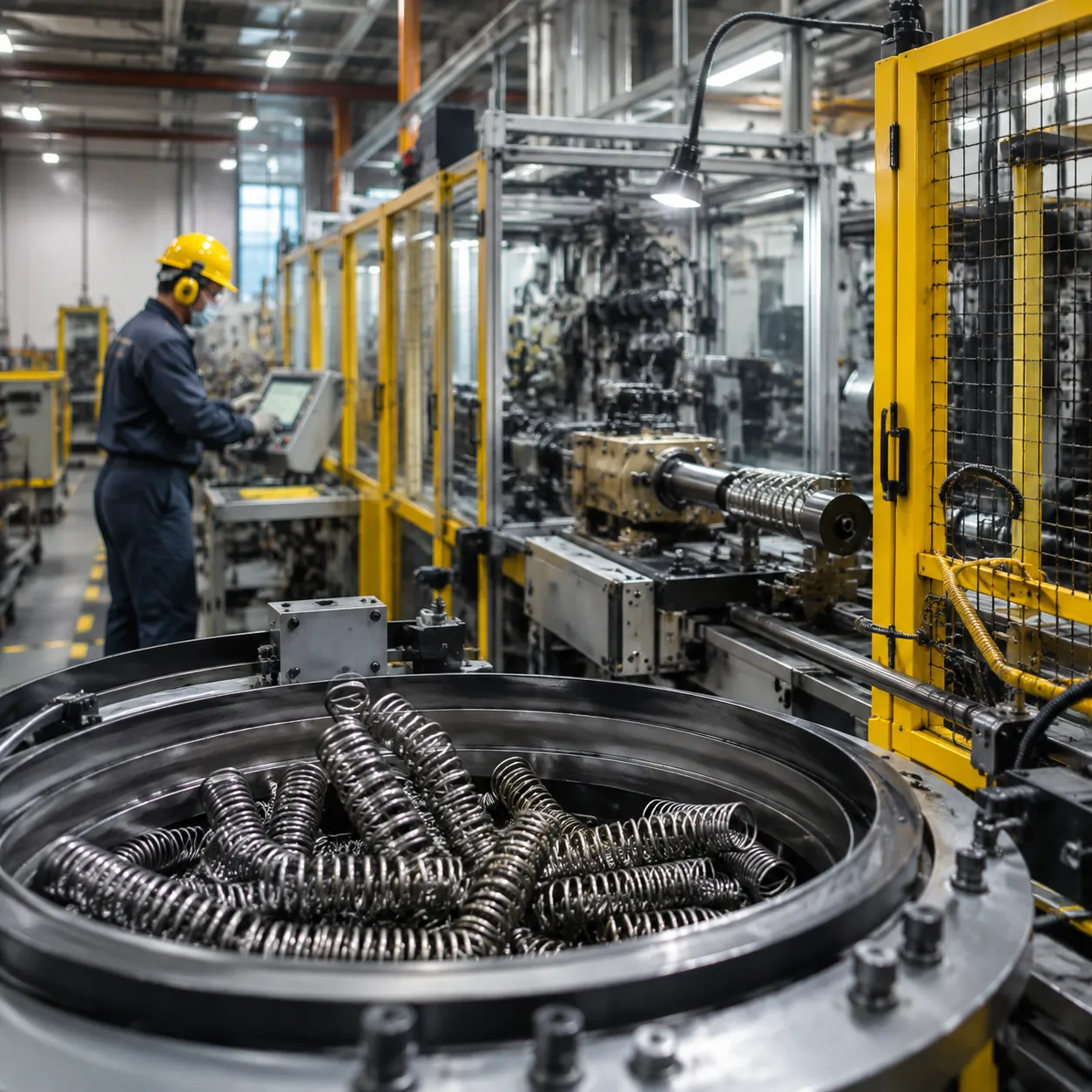
Choosing the right material determines how effectively your spring compression performs under stress, temperature variations, and corrosive conditions. As a professional mechanical springs manufacturer, we select high-grade spring steel wire and alloys to ensure long cyclic life and reliable energy storage.
Music Wire and Carbon Steel
High-carbon steels are the most popular choices for general-purpose applications requiring high strength and high fatigue resistance.
- Music Wire (ASTM A228): Delivers exceptionally high tensile strength and toughness. It handles high cyclic shock loads easily but requires protective plating (such as zinc or nickel) for moisture resistance.
- Hard Drawn Carbon Steel: A cost-effective solution for standard applications with low-stress or static loads.
- Oil Tempered Steel: Ideal for high-stress dynamic applications requiring a larger wire diameter.
Stainless Steel Alloys
When operating environments involve humidity, chemicals, or elevated temperatures, stainless steel provides inherent corrosion resistance without requiring post-plate finishes.
- 302 / 304 Stainless Steel: The standard choice for food processing, medical devices, and outdoor applications. It balances high strength with excellent corrosion defense.
- 316 Stainless Steel: Offers superior resistance to chlorides, marine salt, and aggressive acids. Review our detailed compression spring stainless guide for temperature ratings and grade selection.
- 17-7 PH Stainless Steel: Combines high strength with heat resistance for operating conditions up to 600°F (315°C).
Specialty Alloys and Non-Ferrous Materials
For extreme thermal conditions, chemical exposure, or electrical demands, specialty materials are available. Explore our full breakdown of compression spring materials and types to select the right fit for your custom setup.
- Inconel Alloys (X-750 / 718): Retains mechanical strength and oxidation resistance at extreme temperatures exceeding 1,000°F (538°C).
- Phosphor Bronze & Beryllium Copper: Provides excellent electrical conductivity and non-magnetic properties for electronics and spark-resistant tools.
- Titanium: Delivers a superior strength-to-weight ratio and biocompatibility for aerospace and medical components.
Key Parameters and How to Measure Compression Springs
Getting exact measurements on a helical coil is vital for proper fit, clearance, and predictable spring compression performance. You can explore complete dimensioning standards in our comprehensive mechanical springs guide. We use digital calipers and force testing equipment to measure these core parameters accurately.
| Parameter | Measurement Definition | Primary Tool |
|---|---|---|
| Wire Diameter | Thickness of the individual spring steel wire strand | Micrometer / Caliper |
| Free Length | Total overall height when no load is applied | Caliper / Height Gauge |
| Outer Diameter (OD) | Width across the outermost coil edges | Digital Caliper |
| Inner Diameter (ID) | Inside clearance space across the coil | Inside Caliper / Plug Gauge |
| Spring Rate | Amount of force required per unit of compression distance | Load Testing Meter |
Wire Diameter and Free Length
- Wire Diameter: Measure the spring steel wire across a single strand. Take readings at multiple points to verify consistency, as small diameter changes drastically alter spring stiffness.
- Free Length: Place the open coiled spring on a flat surface without applying axial pressure. Measure the total length from top to bottom while the spring rests completely uncompressed.
Outer Diameter (OD) and Inner Diameter (ID)
- Outer Diameter (OD): Measure straight across the exterior of the coils. This dimension ensures the spring fits smoothly inside a housing or cylinder without binding during operation.
- Inner Diameter (ID): Measure the open space inside the coils. This parameter is critical when mounting the spring over an internal guide rod or shaft.
- Coil Pitch: Measure the center-to-center distance between consecutive active coils to evaluate overall travel distance and stroke length.
Spring Rate and Load Capacity
- Spring Rate: This measures spring stiffness, expressed in pounds per inch (lb/in) or Newtons per millimeter (N/mm). It determines how much resistance the spring provides under load.
- Load Capacity: The maximum working force the spring can sustain before reaching solid height without losing its structural integrity. Correct load calculation ensures maximum potential energy storage throughout repeated cycles. For high-force setups, check out our heavy-duty compression springs guide to evaluate load limits under extreme conditions.
Industrial and Everyday Applications of Compression Springs
Compression springs are vital mechanical components found across virtually every global industry. By absorbing axial pressure and delivering consistent pushing force, these helical coil units ensure equipment operates reliably under severe mechanical stress.
Automotive and Aerospace Systems
In high-performance transportation, precise spring compression delivers safety, vehicle stability, and motion control:
- Suspension Systems: Large coil springs absorb road shocks, maintaining tire contact and ride stability.
- Engine Valve Trains: High-durability springs ensure precise valve opening and closing at thousands of RPMs.
- Aerospace Controls: Flight control mechanisms, landing gear actuators, and braking systems rely on reliable energy storage components to function under extreme temperatures and pressures.
Industrial Equipment and Heavy Machinery
Heavy machinery relies on robust spring designs to manage massive loads and continuous working cycles. Our comprehensive industrial spring guide details how proper spring selection prevents operational fatigue in demanding manufacturing operations.
- Valves and Actuators: Regulate fluid and gas pressure across processing plants, hydraulic units, and pipeline systems.
- Stamping and Tooling: Heavy-duty die springs withstand massive impact forces during high-speed metal stamping.
- Agricultural Equipment: Planters, harvesters, and tractors utilize heavy-duty springs for tension adjustment and ground shock absorption.
Electronics and Consumer Products
From miniature battery contacts to everyday hardware, small compression springs provide exact, repeatable force in compact spaces:
- Consumer Electronics: Micro springs maintain electrical contact in battery compartments, key switches, and handheld devices.
- Household Hardware: Ballpoint pens, door handles, cabinet latches, and power tools rely on consistent return action.
- Medical Devices: Syringes, surgical tools, and auto-injectors require strict wire diameter and outer diameter tolerances. As a leading custom spring manufacturer for precision industrial springs, we build micro-components engineered to meet exacting global standards.
Critical Compression Spring Design Considerations
Designing a high-performing helical coil requires balancing mechanical load with long-term reliability. As a professional mechanical springs manufacturer, we ensure every spring compression application accounts for environmental factors, spatial limits, and material stress.
Operating Environment and Corrosion Resistance
The surrounding environment directly dictates material choice and protective coatings. Exposure to moisture, high temperatures, or aggressive chemicals causes rapid material degradation if unaddressed.
- Stainless Steel & Special Alloys: Ideal for high-moisture or chemical exposure to prevent rust.
- Surface Finishes: Zinc plating, passivation, or powder coating extend service life for standard spring steel wire.
- Temperature Limits: Extreme heat reduces spring rate and potential energy storage, requiring heat-resistant alloys like Inconel.
Solid Height and Buckling Resistance
Solid height is the total length of the spring when compressed completely flat with all coils touching. Oversights in solid height lead to mechanical binding and premature failure under axial pressure.
- Slenderness Ratio: If the free length is more than four times the outer diameter, the spring risks bending sideways under load.
- Guide Rods & Tubes: Long springs require internal rods or external tubes to maintain alignment and prevent buckling.
- Precise Calculations: Refer to our spring compression formula guide for spring design to accurately compute solid height, coil pitch, and maximum safe compression limits.
Stress Relief and Fatigue Life
To endure millions of cycles without structural failure, springs must undergo specialized post-winding processes to maximize operational life.
- Thermal Stress Relieving: Heat treating relieves residual tension introduced during the coiling process.
- Shot Peening: Blasting the wire surface compresses outer layers, significantly boosting fatigue life and resistance to micro-cracks.
- Working Stress Limits: Keeping operational stress within safe mechanical limits prevents permanent deformation and loss of free length over time.
How to Choose Between Stock and Custom Compression Springs
Deciding between off-the-shelf options and engineered components depends on your timeline, budget, and specific application requirements. Finding the right balance ensures optimal performance and reliable spring compression under real-world operating loads. As a professional mechanical springs manufacturer, we help clients evaluate their exact mechanical demands before choosing a path.
| Feature | Stock Compression Springs | Custom Compression Springs |
|---|---|---|
| Lead Time | Immediate dispatch | Production turnaround required |
| Tooling Costs | Zero setup charges | Initial setup/tooling investment |
| Design Flexibility | Fixed standard sizes | Tailored coil pitch, wire diameter, and dimensions |
| Best For | Prototyping, low-budget builds, standard setups | Unique spaces, harsh environments, critical loads |
Selecting Standard Stock Compression Springs
Standard off-the-shelf options work best when your mechanical assembly accommodates standard dimensions. If your system design allows flexibility in free length, outer diameter, and wire diameter, stock options significantly reduce initial engineering expenses and turnaround times.
- Fast Prototyping: Ideal for testing early-stage mechanical designs without waiting for custom manufacturing runs.
- Cost Efficiency: Eliminates setup fees, making small-batch ordering economical.
- Standard Specifications: Easily matched using our compression springs by size guide to identify pre-engineered open coiled designs.
Custom Compression Spring Design and Specs
When standard off-the-shelf sizes fail to handle extreme operating stress, tight physical footprints, or specific potential energy storage demands, custom design is required. Tailored manufacturing ensures exact load rates and reliable axial pressure handling across high-cycle operations.
- Precise Performance: Custom coil pitch and spring steel wire selection deliver exact rate and load capacity.
- Environmental Resistance: Material selection tailored for extreme heat, corrosive chemicals, or non-magnetic requirements.
- Tight Tolerances: Engineered to fit non-standard housings while avoiding solid height clearance issues and buckling.
If your project demands strict tolerances or specialized helical coil configurations, explore our custom compression spring manufacturing options to craft components engineered to your exact operational specs.


