

What Is a Spring in Mechanical Engineering?
Definition and Basic Operating Principle
In mechanical engineering, a spring is defined as an elastic mechanical component designed to exert a force in response to an external load. Its fundamental operating principle relies on the property of elasticity, which allows the object to undergo reversible deformation. When an external force—such as compression, tension, or torque—is applied, the spring changes its shape. Once that force is removed, the spring effectively returns to its original geometry, provided the load does not exceed the material's elastic limit. This capability to store and release energy makes springs essential components across virtually every industry, from automotive suspensions to precision electronics.
Fundamental Physics and Hooke's Law
The behavior of most mechanical springs is governed by the principles of linear elasticity, commonly described by Hooke's Law. This physical law dictates that the force required to extend or compress a spring is proportional to the distance of that displacement.
The relationship is typically expressed as follows:
F = kx
F represents the force exerted by the spring.
k denotes the spring constant, or stiffness, which is unique to the material, coil design, and manufacturing specifications of the spring.
x is the displacement or distance of the spring from its resting, equilibrium position.
If a spring is stretched or compressed beyond its proportional limit, it may experience permanent deformation. This means it will no longer return to its initial, unstressed shape. Understanding this elastic limit is critical for engineers when designing systems that require long-term reliability, precise calibration, and structural integrity.
Energy Storage and Force Generation
Beyond providing structural support, springs function as efficient storage devices for mechanical energy. When a spring is compressed or extended, it accumulates potential energy. This energy can be stored and then released either instantaneously or gradually to perform specific work or provide constant, controlled force.
Engineers utilize this energy storage capability for several key mechanical functions:
Force Regulation: Maintaining consistent pressure between two contacting surfaces.
Shock Absorption: Dissipating impact energy in vehicles and heavy machinery to protect sensitive internal components.
Energy Return: Storing energy during a mechanical stroke to return a component to its starting position, such as in recoil systems or return springs in machinery.
Component Positioning: Holding parts in a specific alignment or under constant tension within an assembly.
By carefully selecting the wire diameter, material properties, coil count, and coil geometry, manufacturers can tailor these performance characteristics to meet exact industrial requirements.
How Do Mechanical Springs Work?
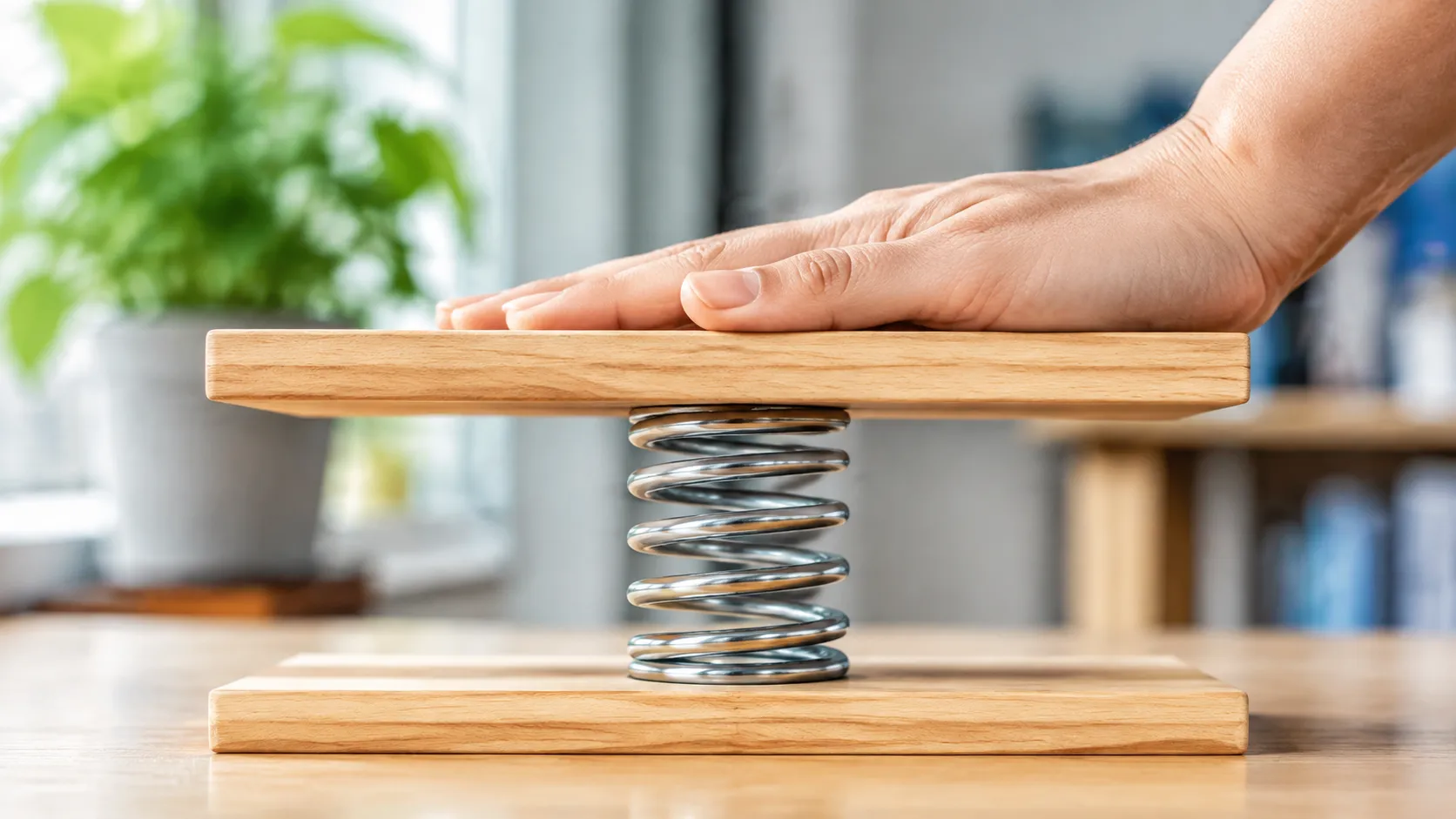
At our manufacturing facility, we look at mechanical springs as energy reservoirs. Every spring operates on a straightforward principle: it resists an applied load, undergoes controlled movement, and returns to its original position once the load disappears. Whether dealing with heavy industrial machinery or miniature assemblies, an elastic mechanical component must reliably store and release energy without losing its structural integrity.
Elastic Deformation and Recovery
When you apply force to a spring, its material undergoes elastic deformation. On a microscopic level, the atoms within the metal alloy displace slightly from their equilibrium positions, absorbing the input work.
- Elastic Zone: As long as stress stays below the material's yield strength, the atomic bonds act like tiny internal flex points, pulling the structure back to its initial shape upon release.
- Plastic Zone: If the load exceeds the yield point, the metal experiences permanent plastic deformation, ruining the spring's geometry and performance.
- Energy Storage: The energy put into compressing, extending, or twisting the part stays locked within the material as strain energy until the external load drops.
Spring Rate and Load Deflection
The core operational metric of any spring is its spring rate (often labeled as k). It defines the amount of force needed to travel a specific distance:
$Spring Rate (k) = frac{Applied Force (F)}{Deflection (delta)}$
| Parameter | Function | Practical Impact |
|---|---|---|
| High Spring Rate | Stiff spring; requires high force for minimal travel | Ideal for heavy tooling, die sets, and structural support |
| Low Spring Rate | Soft spring; deflects easily under light loads | Ideal for sensitive valves, electronic contacts, and latches |
| Linear Deflection | Force scales evenly with travel distance | Standard across most helical compression springs and tension springs |
| Variable Rate | Resistance increases progressively as the spring deflects | Critical for dynamic loads and preventing bottoming-out |
Selecting the exact rate guarantees that the assembly responds predictably under working loads. For an in-depth breakdown of geometry and rate calculations, explore our detailed mechanical springs guide.
Damping and Shock Absorption
Springs excel at shock absorption by spreading high-energy impact forces over a longer displacement cycle. When a sudden shock hits an assembly, the spring deflects rapidly, converting violent kinetic spikes into stored potential energy.
- Impact Mitigation: By extending the deceleration distance, the peak shock forces transmitted to surrounding components drop significantly.
- System Damping: While springs store and return energy, they do not dissipate it alone. Pairing springs with hydraulic or friction dampers prevents endless resonance cycles, keeping machinery stable and protected from destructive vibration frequencies.
Major Types of Springs Based on Mechanical Function
In the world of mechanical engineering, springs are categorized primarily by how they manage force and load. Understanding the specific function of a spring is critical, as the design geometry dictates how effectively it can store and release energy for your specific application.
Compression Springs
Compression springs are open-coil helical springs that offer resistance to a compressive force applied along the axis. When a load is placed on these springs, they shorten, effectively storing potential energy until the load is released, at which point the spring returns to its original length. These are the most common springs you will encounter, found in everything from vehicle suspensions to ballpoint pens.
Whether you are looking for standard off-the-shelf components or require custom engineering, choosing the right compression springs for sale is essential to ensure the longevity and performance of your machinery. These springs are designed to handle heavy loads while maintaining stable resistance, making them a staple in automotive and industrial manufacturing.
Extension Springs
Extension springs, often referred to as tension springs, function in the opposite manner of compression springs. Instead of resisting compression, they are designed to absorb and store energy by creating tension. They are typically coiled tightly and feature specialized hooks, loops, or ends that allow them to be attached to two separate components.
When a force pulls the attachment points apart, the spring resists the movement and attempts to pull the components back together. You will frequently find these in applications requiring a return force, such as trampoline systems, garage door mechanisms, and various counterbalancing devices in industrial equipment.
Torsion Springs
Torsion springs are unique because they operate through angular rotation rather than linear compression or extension. They store and release energy through a twisting motion. When torque is applied to the arms of the spring, the coils tighten and store potential energy, which is then released as the spring tries to return to its original position.
The most common examples of torsion springs include:
Hinges and Latches: Providing the resistance needed for doors to swing shut.
Clothespins: Creating the clamping force necessary to hold items in place.
Vehicle Systems: Often used in automotive suspension to manage rotational forces.
Because they rely on the elastic properties of the material to resist torque, selecting the correct wire diameter and coil count is critical for achieving the precise spring rate required for your specific design constraints.
Common Spring Types Based on Design and Geometry
Helical Springs
Helical springs are arguably the most recognizable elastic mechanical component used in engineering. These springs are formed by coiling wire into a cylindrical shape, allowing them to store and release energy efficiently. Their design flexibility makes them suitable for a wide range of tasks, from simple tension in consumer goods to heavy-duty compression in industrial machinery. Depending on the pitch and wire gauge, these springs can effectively manage compression, tension, or torsion forces.
Leaf Springs
Leaf springs are a classic solution for handling heavy vertical loads and providing stable suspension. They consist of multiple metal plates, or "leaves," stacked on top of one another and secured together. This design is exceptionally durable, which is why they are standard in trucks, trains, and other heavy-duty transportation systems. For those interested in the structural mechanics and specific performance benefits of this design, you can review our guide on leaf springs to learn more about how they are utilized in industrial and automotive applications.
Disc Springs (Belleville Washers)
Disc springs, commonly referred to as Belleville washers, feature a unique conical shape that allows them to support high loads while occupying minimal space. Unlike traditional coiled springs, these are stacked or arranged in series to achieve specific load-deflection characteristics. They are the preferred choice for applications where space is extremely limited but high force is required, such as in bolted joints, clutches, or heavy machinery where thermal expansion needs to be compensated.
Gas and Wave Springs
Gas springs and wave springs offer specialized solutions for modern engineering challenges. Gas springs utilize compressed nitrogen contained within a cylinder to provide a controlled, smooth lifting or dampening force, making them essential for office furniture, automotive tailgates, and aerospace hatches. Conversely, wave springs are made from flat wire coiled in a wave pattern. They provide a space-saving alternative to standard helical springs, as they can deliver equivalent force and deflection in a much smaller axial footprint, making them ideal for high-precision, compact assemblies.
Materials Used in Mechanical Spring Manufacturing
Material selection dictates how an elastic mechanical component performs under repetitive stress, heat, and corrosive environments. Choosing the proper wire or strip ensures the component can repeatedly store and release energy without taking a permanent set or experiencing premature fatigue failure. We are a professional mechanical springs manufacturer and supplier, and we engineer each component to match precise load specs, fatigue cycles, and operating conditions.
High-Carbon Spring Steels
High-carbon steels are the most widely used materials in standard mechanical engineering. They deliver high tensile strength, exceptional elastic deformation capacity, and reliable durability at an economical price point.
- Music Wire (ASTM A228): The industry standard for high-stress applications. Offers exceptional tensile strength and uniform mechanical properties for small-diameter springs. Best suited for indoor environments with moderate temperatures (up to 120°C / 250°F).
- Hard Drawn Wire (ASTM A227): A general-purpose, cost-effective cold-drawn wire used for low-stress, static, or low-cycle applications where high precision is not mandatory.
- Oil-Tempered Wire (ASTM A229): Heat-treated general-purpose wire often used in larger wire diameters for agricultural and industrial equipment.
Because high-carbon steels are prone to oxidation, they typically require surface treatments such as zinc plating, black oxide, or powder coating to prevent rust.
Alloy and Stainless Steels
When designs demand high shock absorption, extended fatigue life, or corrosion protection, alloy and stainless steels become essential.
- Chrome Silicon (ASTM A401): Engineered for high-stress, high-impact cyclic conditions. It maintains structural integrity under rapid cycling and operates reliably up to 245°C (475°F).
- Chrome Vanadium (ASTM A231): Commonly used for heavy-duty automotive valve springs and industrial equipment where high fatigue resistance is mandatory.
- Stainless Steel 302/304: Standard austenitic alloys offering excellent corrosion resistance, non-magnetic properties (when fully annealed), and an operating ceiling of 260°C (500°F).
- Stainless Steel 316: Formulated with molybdenum for superior resistance to chlorides, marine exposure, and acidic chemicals.
- 17-7 PH Stainless Steel: A precipitation-hardened alloy that combines high tensile strength with exceptional fatigue properties, ideal for intricate parts outlined in our compression spring materials and selection guide.
These materials are standard for critical compression springs and tension springs operating in humid, chemical, or automotive under-the-hood conditions.
Non-Ferrous Alloys and Superalloys
Extreme environments requiring non-magnetic qualities, electrical conductivity, or performance under high temperatures rely on specialty non-ferrous materials and superalloys.
| Material Class | Common Alloys | Max Operating Temp | Key Engineering Advantage |
|---|---|---|---|
| Copper Alloys | Phosphor Bronze, Beryllium Copper | 100°C – 200°C | Excellent electrical conductivity, spark resistance, and low magnetic permeability |
| Nickel Superalloys | Inconel X-750, Inconel 718 | 550°C – 700°C | Extreme heat resistance, oxidation resistance, and high tensile strength at sub-zero and elevated temps |
| Titanium Alloys | Grade 5 (Ti-6Al-4V) | 350°C – 430°C | High strength-to-weight ratio, exceptional corrosion resistance, and low shear modulus |
These alloys are critical in aerospace propulsion, downhole oil drilling tools, medical instruments, and deep-sea systems where standard steels fail rapidly due to stress corrosion or thermal degradation.
Key Applications of Springs in Engineering
As an essential elastic mechanical component, springs are built into almost every mechanical assembly. Their primary role across modern industries is to store and release energy, dampen shock, hold tension, and ensure mechanism reset. As a professional mechanical springs manufacturer and supplier, we engineer these components to meet rigorous performance demands across a wide variety of sectors.
Automotive and Transportation Systems
Vehicles experience continuous dynamic forces, making springs crucial for safety, comfort, and control:
- Suspension Systems: Heavy-duty coil springs absorb road roughness, stabilize vehicle weight, and deliver continuous shock absorption.
- Engine Valvetrains: High-frequency compression springs return intake and exhaust valves to their seats rapidly, keeping timing precise at high RPMs.
- Braking and Clutches: Tension springs and return springs retract pads, pedals, and clutch plates reliably once operator pressure is released.
- Safety Mechanisms: Seatbelt retractors and airbag sensors use specialized torsion and flat springs for immediate response upon impact.
Industrial Machinery and Heavy Equipment
Heavy manufacturing processes subject tooling to extreme cyclic stress. In tooling and metal-stamping equipment, selecting the right design requires understanding compression and die springs differences to handle high-load, short-stroke cycles without fatigue failure.
For large-scale agricultural, earthmoving, and mining machines, we provide heavy-duty compression springs engineered to maintain structural tension, isolate harsh vibrations, and protect hydraulic actuators from continuous shock.
| Industrial Equipment | Primary Spring Function |
|---|---|
| Metal Stamping Presses | Provides rapid counter-force and punch retraction |
| Fluid Control Valves | Maintains preset sealing pressure to prevent pipeline leaks |
| Conveyor Tensioners | Delivers continuous tension to balance belt wear and thermal expansion |
Aerospace and Defense Applications
Aerospace mechanisms require zero-failure reliability under severe operating conditions:
- Landing Gear: Advanced shock absorption springs handle massive landing impacts while providing stable ground-taxi performance.
- Actuation and Flight Controls: Wing flaps, thrust reversers, and rudder systems rely on custom-machined springs for precise force feedback and mechanical fail-safes.
- Satellite Mechanisms: Compact deployment springs release solar panels and communication arrays once orbit is achieved, operating dependably without lubrication in extreme thermal vacuums.
Consumer Electronics and Everyday Devices
Micro-scale springs control tactile feedback, mechanical connection, and retention in daily goods:
- Battery Contacts: Conical and tiny compression springs hold batteries securely in place and ensure uninterrupted electrical flow.
- Smartphones and Cameras: Miniature springs stabilize optical image sensors and support mechanical buttons.
- Everyday Hardware: Retractable pens, deadbolts, power tools, and kitchen appliances depend on basic elastic deformation to reset switches, latches, and triggers back to their resting states.
Factors to Consider When Selecting and Designing a Spring
Selecting or designing the right spring is a critical engineering task that balances performance with durability. Whether you are dealing with standard components or custom manufacturing, the following parameters define the success and longevity of the mechanical assembly.
Load Requirements and Deflection
Understanding the relationship between force and displacement is essential. You must determine the exact load the spring needs to exert at specific lengths, often referred to as the spring rate or stiffness. When designing, engineers must account for the spring’s free length, solid height, and the necessary working range to prevent coil binding or insufficient force. For engineers, calculating spring compression equations is the first step in ensuring the spring meets specific load requirements and maintains functional integrity under pressure.
Operating Environment and Temperature
The environment in which a spring operates significantly dictates material selection. Exposure to moisture, chemicals, or extreme thermal conditions can lead to premature failure via corrosion or stress relaxation.
- Corrosion Resistance: Stainless steels or specialized coatings are required for marine or chemical environments.
- Temperature Extremes: High-temperature applications require superalloys to prevent loss of elasticity and structural deformation.
- Compatibility: Consult our comprehensive compression spring guide when assessing material compatibility with your specific operating environment to ensure long-term stability.
Space Constraints and Installation
Physical limitations often dictate the geometry of the spring. Designers must work within the confines of the housing assembly, considering:
- Outer Diameter (OD): Must fit within the intended cavity without rubbing against walls.
- Inner Diameter (ID): Must allow clearance for rods or guides if present.
- Free Length: The total space available when the spring is at rest.
- Solid Height: The minimum length the spring can reach under maximum load.
Fatigue Life and Material Durability
Fatigue life refers to the number of cycles a spring can endure before failure. High-cycle applications, such as in automotive engines, require materials with high fatigue strength and precise stress calculations.
| Factor | Critical Consideration |
|---|---|
| Cycle Count | Expected number of compressions/extensions over the lifetime. |
| Stress Levels | Keeping working stress below the elastic limit of the material. |
| Material Choice | Selecting high-carbon steel vs. alloys based on endurance requirements. |
| Surface Finish | Shot peening can be used to improve resistance to fatigue cracking. |
Prioritizing these factors during the initial design phase minimizes the risk of component failure and ensures that the chosen spring provides reliable, consistent performance throughout its intended service life.

