

What Is the Maximum Compression of a Spring?
In physics and mechanical engineering, the compression of a spring refers to the linear distance the component contracts under an applied compressive load. Determining the maximum compression establishes the operational threshold a spring can withstand before reaching structural limits, plastic deformation, or mechanical interference.
Definition of Spring Compression in Physics
Spring compression is the change in overall length when external forces push the ends of the spring toward each other along its central axis.
-
- Free Length: The total natural length of the spring in an uncompressed state without any external load applied.
- Compressed Length: The reduced overall dimension when an axial compressive force acts upon the coils.
- Deflection: The quantitative difference between the free length and the loaded length, governed fundamentally within elastic limits by Hooke's law.
As a professional mechanical springs manufacturer and supplier, precise calculation of this dimensional change ensures that mechanical assemblies operate predictably, reliably, and safely within their intended mechanical parameters.
The Physical Meaning of Maximum Displacement (x)
In classic physics equations, spring displacement is universally denoted by the variable x (or Δx). When calculating maximum compression, displacement represents the absolute upper boundary of linear movement:
-
- Elastic Maximum Deflection: The maximum distance the spring can compress while still returning completely to its original free length upon load removal. Exceeding this boundary causes permanent deformation.
- Solid Height Limit: The physical barrier where all active coils compress tightly against one another, eliminating all pitch and air gaps. At this point, displacement stops completely, and the spring functions as a solid steel tube.
Because maximum displacement represents a physical shift in position between two points, its primary identity in physics is purely a measure of length and distance.
What Unit Is Maximum Compression of a Spring in Physics?
In physics, the maximum compression of a spring measures linear displacement—the total distance a spring compresses under load before reaching its travel limit or solid height. Because compression measures distance, its standard measurement is an expression of length. The direct answer to what unit is maximum compression of a spring in physics is the meter (m) under the International System of Units (SI).
Depending on whether you are working through theoretical physics problems or inspecting physical hardware on a shop floor, several standard metric and imperial units are used to quantify this value.
The SI Standard Unit: Meters (m)
The meter (m) serves as the base SI unit of displacement in standard physics equations. When calculating spring dynamics via Hookes law or analyzing stored elastic potential energy, all distance terms must stay in meters to maintain dimensional consistency.
Using meters ensures that standard units align across fundamental equations:
Displacement ($x$): Meters (m)
Force ($F$): Newtons (N, or kg·m/s²)
Spring Constant ($k$): Newtons per meter (N/m)
When applying formulas outlined in our spring compression equation guide for design and testing, theoretical models always resolve to meters to correctly match the force constant and energy outputs measured in Joules.
Metric Derivatives: Centimeters (cm) and Millimeters (mm)
While pure physics problems rely on meters, real-world mechanical components rarely undergo full meters of travel. In laboratory settings, education, and manufacturing, metric derivatives are far more practical:
-
- Millimeters (mm): The global standard in mechanical engineering and precision fabrication. Wire diameters, pitch, and total stroke limits are routinely defined in millimeters to avoid cumbersome decimals.
- Centimeters (cm): Frequently utilized in secondary physics curricula and benchtop force-displacement experiments.
Conversion Reference:
1 m = 100 cm
1 m = 1,000 mm
1 mm = 0.001 m
Before substituting millimetric compression values into formulas involving a standard spring constant expressed in N/m, always convert millimeters back into meters.
Imperial Units: Inches (in)
In the United States and regions utilizing customary imperial systems, maximum spring compression is measured in inches (in) or fractions of an inch.
-
- Linear Compression: Inches (in)
- Associated Force: Pounds-force (lbf)
- Spring Rate / Stiffness: Pounds per inch (lbf/in)
For large industrial installations, travel may occasionally be documented in feet (ft), where 1 ft equals 12 inches. When converting between systems:
1 inch = 25.4 millimeters
1 inch = 0.0254 meters
We are a professional mechanical springs manufacturer and supplier, and our engineering teams regularly balance both metric and imperial requirements to verify that calculated maximum deflection limits match exact operational tolerances without risking permanent set.
Spring Compression vs. Spring Constant: Key Unit Differences
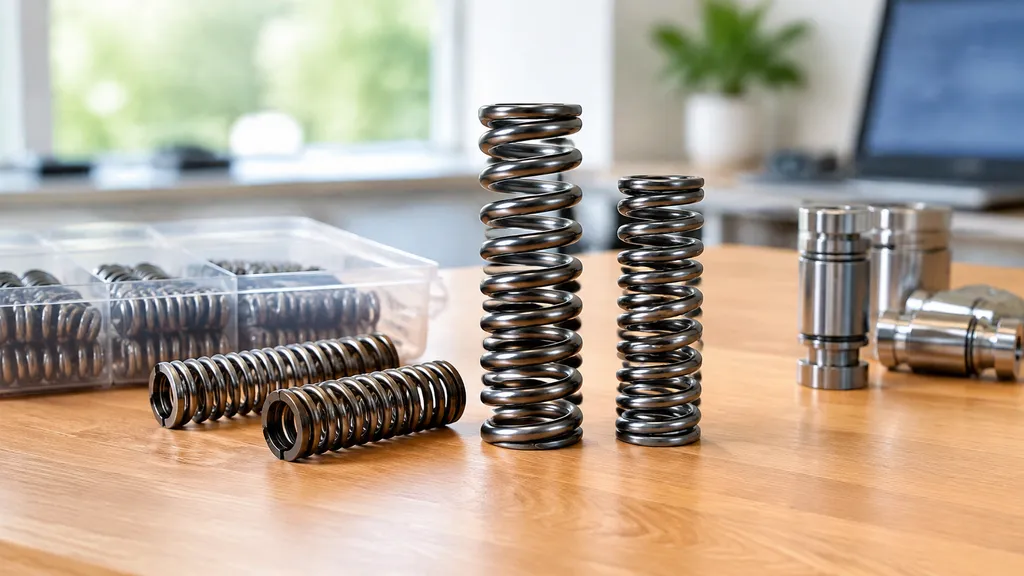
It is common to confuse the unit for maximum compression with the unit for the spring constant. In physics and engineering, these two parameters represent completely different physical properties. Compression measures a distance or length, while the spring constant measures mechanical stiffness.
When asking what unit is maximum compression of a spring in physics, remember that compression is simply a measure of linear displacement. Therefore, its primary SI unit is meters (m), whereas the spring constant describes how much force is required to achieve a specific amount of compression.
Units of Spring Constant (N/m and lbf/in)
The spring constant, often called the force constant and denoted as k, indicates how rigid a spring is. It defines the ratio of applied force to the resulting displacement under Hookes law.
-
- SI System: The standard unit is Newtons per meter (N/m). In heavy industrial or high-load applications, you may also see Newtons per millimeter (N/mm).
- Imperial System: The standard unit is pounds-force per inch (lbf/in).
We are a professional mechanical springs manufacturer and supplier, and we calculate these load-to-deflection ratios carefully across our production lines. For complex assemblies or high-stress machinery, selecting the correct stiffness rating is critical; you can explore our detailed guide to compression spring types and materials to see how wire diameter, pitch, and material selection dictate these values in practice.
Distinguishing Force, Stiffness, and Displacement
To keep equations accurate, keep force, stiffness, and displacement distinct. Hookes law links these three terms through the formula F = kx:
-
- Force (F): The push or pull applied to the spring.
- Spring Constant (k): The force constant reflecting spring rigidity.
- Displacement / Maximum Compression (x): The actual change in length from the spring's uncompressed state, governed by the SI unit of displacement.
| Property | Symbol | Physical Meaning | SI Standard Unit | Common Engineering Unit | Imperial Unit |
|---|---|---|---|---|---|
| Applied Force | F | Total load exerted on the spring | Newton (N) | Kilonewton (kN) | Pound-force (lbf) |
| Spring Constant | k | Stiffness / force required per unit length | N/m | N/mm | lbf/in |
| Maximum Compression | x | Linear travel distance from free length | Meter (m) | Millimeter (mm) | Inch (in) |
Maximum compression always remains a measure of distance. It cannot be expressed in Newtons or Newtons per meter.
How to Calculate the Maximum Compression of a Spring
When determining what unit is maximum compression of a spring in physics, your calculations will always output a unit of linear distance—predominantly the meter (m) in standard physics problems, or millimeters (mm) in practical workshop tooling. As a professional mechanical springs manufacturer and supplier, we calculate these values daily to ensure springs operate safely within their elastic limits under both static and dynamic loads.
Depending on how load is delivered to the component, you can calculate maximum compression displacement through static equilibrium, kinetic energy transfer, or dynamic harmonic motion.
Calculating Compression Using Hooke's Law
For static or gradually applied forces, linear deflection follows Hooke's law. In this linear range, the displacement is directly proportional to the applied load:
-
- Basic Equation: F = k * x
- Rearranged for Compression: x = F / k
Here, F represents the peak applied force in newtons (N), k is the spring constant or force constant in newtons per meter (N/m), and x is the resulting maximum compression distance in meters (m). For a comprehensive breakdown of static load calculations, review our compression of a spring equation guide to Hooke's law.
Calculating Maximum Compression via Conservation of Energy
When a moving object impacts a spring, maximum compression occurs at the precise moment all kinetic energy converts into elastic potential energy (assuming no frictional losses):
-
- Kinetic Energy (Initial): KE = 0.5 * m * v^2
- Elastic Potential Energy (At Max Compression): PE = 0.5 * k * x^2
- Energy Balance Equation: 0.5 * m * v^2 = 0.5 * k * x^2
- Solved for Maximum Compression (x): x = v * sqrt(m / k)
Where:
m = mass of the moving body in kilograms (kg)
v = impact velocity in meters per second (m/s)
k = spring constant in newtons per meter (N/m)
x = maximum compression distance in meters (m)
Because energy and mass are maintained in SI standard units, the resulting value for maximum compression resolves directly into meters.
Solving for Compression in Spring-Mass Systems
In vertical or oscillating spring-mass arrangements, maximum deflection includes gravitational potential along with oscillatory amplitude. For detailed step-by-step mathematical breakdowns across complex assemblies, see our article on the formula for compression of a spring explained.
To find the true peak compression in a falling mass assembly:
-
- Total Energy Conservation: m * g * (h + x) = 0.5 * k * x^2
- Standard Quadratic Form: 0.5 * k * x^2 - (m * g) * x - (m * g * h) = 0
- Variables: g is acceleration due to gravity (9.81 m/s^2), and h is the drop height above the uncompressed spring in meters (m).
Solving this quadratic equation yields the single positive root for x, giving the absolute maximum compression distance reached before the spring pushes the mass back upward.
Factors Affecting Maximum Spring Compression
While theoretical physics models treat springs as ideal objects, the actual maximum compression depends on tangible physical constraints. Understanding what unit is maximum compression of a spring in physics—standardized as the meter (m)—requires examining both mechanical properties and operating loads. Several key variables dictate how far a spring deflects before reaching its boundary.
Spring Constant and Material Elasticity
The spring constant, or force constant, defines how rigid a spring is. Under Hooke's law, displacement is inversely proportional to this constant:
-
- Stiffness Rating: A higher force constant requires significantly more force to achieve each unit of compression.
- Elastic Range: Material elasticity sets the threshold for reversible deformation. Exceeding this yield point causes permanent set, ruining the linear relationship between load and travel.
- Manufacturing Profile: We are a professional mechanical springs manufacturer and supplier, and we engineer wire diameters and active coil counts specifically to control this stiffness. For an in-depth breakdown of geometry and load ratings, consult our compression spring guide.
Applied Force and Impact Velocity
Compression increases with the magnitude of the applied load:
-
- Static Loads: Compression scales linearly with continuous force until the spring reaches solid stop or yields.
- Dynamic Kinetic Energy: When a moving mass strikes a spring, the impact velocity dictates total compression. Because kinetic energy scales with the square of velocity, doubling the entry speed quadruples the energy that must be absorbed as elastic potential energy, driving compression further along its axis of travel.
Physical Limits and Spring Solid Height
In real-world applications, spring travel has an absolute physical ceiling:
-
- Solid Height (Ls): The total height of the spring when every coil is pressed flush against adjacent coils.
- Free Length (Lf): The unconstrained length of the spring without external load.
- True Maximum Deflection: The absolute maximum compression distance cannot exceed the free length minus the solid height.
Whether expressed in the standard SI unit of displacement (meters) or practical workshop units like millimeters, solid height represents an unyielding mechanical limit where all deflection stops.
Step-by-Step Example Problem and Unit Conversion
To understand what unit is maximum compression of a spring in physics, it helps to see how the numbers behave during a real calculation. When solving these problems, consistent units ensure that your final displacement matches standard physical conventions.
Identifying Known Variables and Standardizing Units
Consider an example where a moving object strikes a spring head-on:
-
- Mass of the object (m): 2 kg
- Velocity before impact (v): 3 m/s
- Spring constant or force constant (k): 800 N/m
Before plugging values into any formula, we verify that every parameter uses standard metric values. In this scenario, kilograms (kg), meters per second (m/s), and Newtons per meter (N/m) all align with the metric framework. If you are calculating spring parameters from physical dimensions rather than theoretical values, our compressed spring formula guide for rate and force details how wire size, active coils, and diameter establish stiffness.
Because the input values rely on base metric terms, the final calculated deflection will naturally result in meters, the base SI unit of displacement.
Applying the Energy Formula to Solve for Compression
Assuming zero energy is lost to friction or heat, the kinetic energy of the moving object transfers entirely into elastic potential energy stored in the compressed spring at the instant of maximum deflection:
Kinetic Energy = Elastic Potential Energy
1/2 * m * v^2 = 1/2 * k * x^2
We can simplify the equation by canceling the factor of 1/2 from both sides:
m * v^2 = k * x^2
Next, solve directly for the maximum displacement (x):
x^2 = (m * v^2) / k
x = Square Root of [(m * v^2) / k]
Insert the standardized numbers:
-
- m * v^2 = 2 kg * (3 m/s)^2 = 18 Joules
- x^2 = 18 / 800 = 0.0225
- x = 0.15 meters
The fundamental calculation yields 0.15 meters (m).
Converting Final Displacement to Desired Units
While meters remain the baseline in formal physics equations, working with 0.15 m in mechanical design or fabrication can be awkward. We often convert this value into more practical dimensions:
-
- Millimeters (mm): Multiply meters by 1,000
0.15 m * 1,000 = 150 mm - Centimeters (cm): Multiply meters by 100
0.15 m * 100 = 15 cm - Inches (in): Multiply meters by 39.37 (or divide mm by 25.4)
0.15 m * 39.37 = 5.91 in
- Millimeters (mm): Multiply meters by 1,000
As a professional mechanical springs manufacturer and supplier, we regularly translate displacement values from academic formulas into tight engineering drawings. While physics classrooms rely strictly on meters to keep calculations balanced, mechanical production relies primarily on millimeters or inches to match physical installation tolerances and solid height clearances.
Related Sources
- http://hyperphysics.phy-astr.gsu.edu/hbase/permot2.html
- https://www.khanacademy.org/science/physics/work-and-energy/hookes-law/a/what-is-elastic-potential-energy
- https://www.khanacademy.org/science/physics/work-and-energy/hookes-law/a/what-is-hookes-law
- https://www.engineeringtoolbox.com/compression-springs-d_1380.html
- https://phys.libretexts.org/Bookshelves/University_Physics/University_Physics_(OpenStax


