

Understanding Valve Spring Compressors
A valve spring compressor is a vital mechanical tool designed to collapse a high-tension compression valve spring, allowing safe removal and installation of valve keepers, retainers, and seals. As a professional mechanical springs manufacturer, we understand that precision-engineered springs require specialized handling to maintain long-term component reliability and engine performance.
Function of Valve Spring Compressors in Valvetrains
In any engine assembly, the compression valve spring keeps the valve firmly seated against the cylinder head to maintain proper combustion seal. Servicing these components requires controlled compression to manage high load capacity.
-
- Tension Control: Safely depresses both high-tension single valve springs and complex dual valve springs without slipping.
- Keeper Removal: Exposes valve locks (keepers) for rapid extraction using magnetic tools or manual pliers.
- Stem Alignment: Maintains axial alignment with the valve stem to prevent galling or scoring in the valve guide.
Why Proper Spring Compression Tools Are Essential
Attempting to service springs without dedicated compressors poses significant safety risks and structural damage to the valvetrain.
| Service Factor | Dedicated Compression Tooling | Improvised Methods |
|---|---|---|
| Operator Safety | Secures stored kinetic energy reliably | High risk of sudden spring recoil and injury |
| Component Care | Distributes force evenly across the retainer | Risk of bending valve stems or cracking retainers |
| Casting Integrity | Avoids contact with delicate aluminum ports | Frequent gouging or scoring of the cylinder head |
Main Types of Valve Spring Compressors
Choosing the right tool to safely depress a compression valve spring depends on your valvetrain design and whether you are working on an assembled engine. For additional force calculations and spring parameters, refer to our spring compression guide. Below are the primary compressor styles we manufacture and recommend for professional engine work.
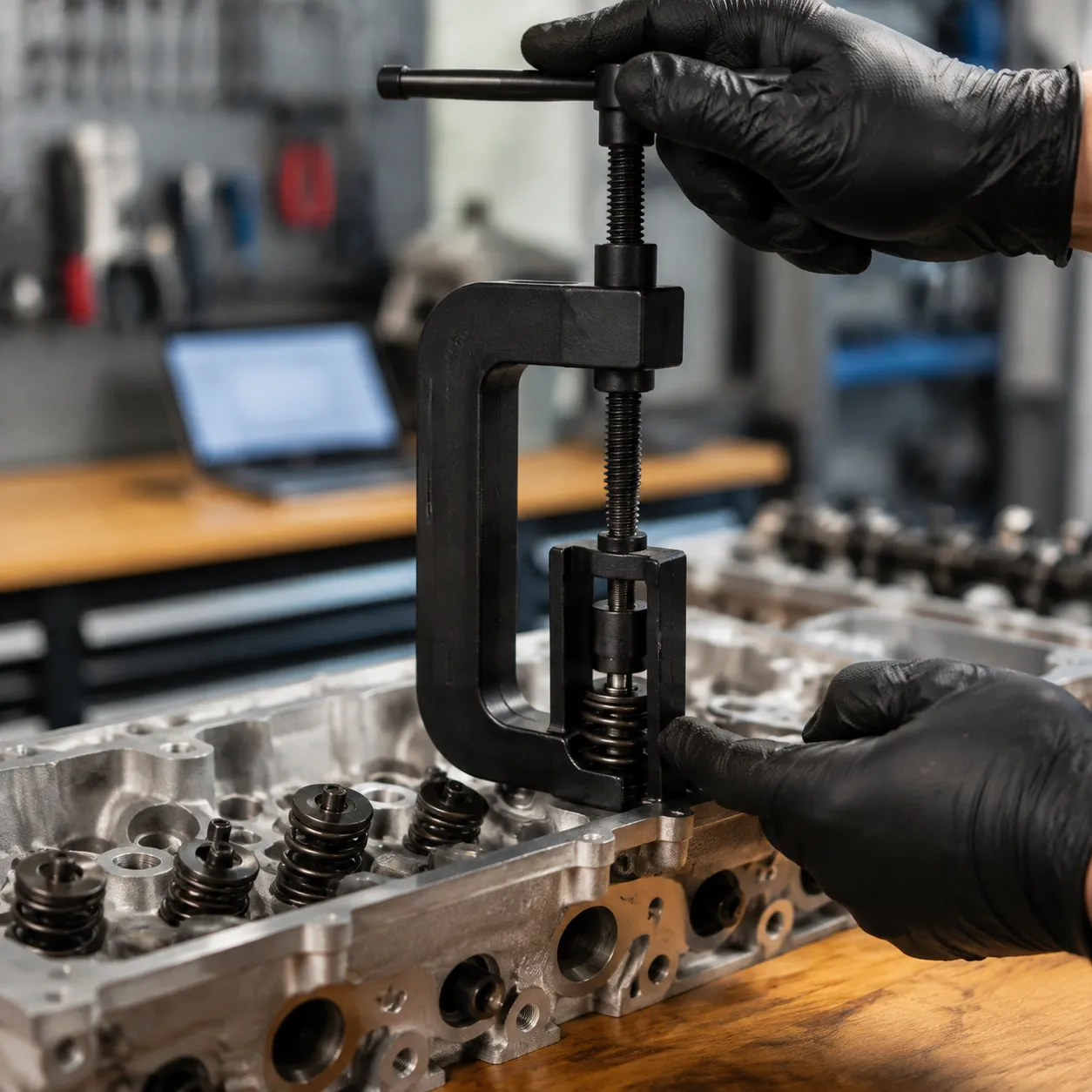
C-Clamp Style Compressors
-
- Best For: Workbench rebuilds with the cylinder head removed.
- Operation: Clamps from the top retainer to the valve face under the head.
- Key Benefit: Provides rigid, slip-free alignment when servicing standard single valve springs and heavy-duty dual valve springs off the engine block.
Overhead Cam (OHC) Compressors
-
- Best For: Modern overhead cam valvetrains with tight clearance.
- Operation: Hooks beneath the camshaft or valvetrain hardware directly inside the head.
- Key Benefit: Allows on-engine spring replacement without pulling the cylinder head. Compact drive heads accept a standard hex wrench or speed handle for quick adjustment.
Stud-Mount and Lever-Style Compressors
-
- Best For: Pushrod engine heads and high-performance racing setups.
- Operation: Mounts directly onto the rocker stud or valve cover bolt hole, using mechanical leverage to compress the spring.
- Key Benefit: Multiplies user leverage, making high-pressure spring removal smooth and predictable.
Pneumatic and Bench-Mount Compressors
-
- Best For: High-volume machine shops and commercial service centers.
- Operation: Powered by shop air or heavy-duty bench-mounted lever frames.
- Key Benefit: A pneumatic spring compressor drastically reduces operator fatigue when handling heavy diesel engines or servicing dozens of valves daily. For smaller shops, a fixed manual bench top unit provides maximum safety and control. Learn more about safety protocols in our strut spring compression tool guide.
Application Scenarios for Valve Spring Compression
Every valvetrain job requires a distinct approach depending on where and how service is performed. As a professional mechanical springs manufacturer, we design spring solutions for every level of engine performance, and matching the right technique to the job prevents tool slippage and component damage. Following a practical valve spring compression tool guide for safe engine repairs ensures fast, safe, and repeatable service across different engine layouts.
On-Engine Valve Spring Replacement
Replacing springs or valve stem seals without pulling the cylinder head off the engine block saves hours of teardown and gasket replacement time. This on-engine technique requires holding the valve shut using compressed air fed into the spark plug hole while compressing the spring from above.
-
- Essential Gear: Lever-style spring tools, overhead bridge clamps, a speed handle, or a precise hex wrench to actuate the tool.
- Best Uses: Servicing single valve springs, replacing cracked retainers, or swapping worn valve seals.
- Safety Step: Always bring the target piston to top dead center (TDC) before removing valve keepers as a secondary precaution against dropping a valve into the cylinder.
Bench-Top Cylinder Head Overhauls
Complete cylinder head reconditioning requires working on a dedicated workbench where accessibility is unconstrained. Removing the head from the block gives complete access to valve guides, seats, and seals.
-
- Manual Bench Top Setups: A heavy-duty C-clamp frame or fixed manual bench top station firmly holds the head, freeing up both hands to manipulate keepers and retainers safely.
- Streamlined Workflow: Allows rapid teardown, spring height measurement, and rebuild of the entire valvetrain in a single controlled session.
- Inspection Advantage: Ideal for detecting stem wear, measuring spring free length, and checking valve seat concentricity.
Heavy-Duty and Performance Engine Applications
High-output race engines and commercial diesel engines feature extreme spring rates and complex valvetrain arrangements that require high-force compression tools.
-
- Dual Spring Demands: Performance engines frequently feature dual valve springs with high seat pressures that manually operated hand tools cannot safely collapse.
- Pneumatic Assist: Utilizing a pneumatic spring compressor applies uniform, controllable force to compress stiff heavy-duty compression springs cleanly without operator fatigue.
- Industrial and Fleet Reliability: Crucial for servicing heavy commercial diesel engines where massive valve springs require steady, industrial-grade clamping force.
How to Choose the Right Valve Spring Compressor
Selecting the right tool ensures safe, efficient valvetrain servicing without damaging components. Review our detailed spring compressor guide to match your specific workshop requirements. As a professional mechanical springs manufacturer, we recommend matching tool capacity directly to spring force and engine layout.
Engine Type and Valvetrain Layout Compatibility
Engine geometry determines which compressor design can physically access the valve setup:
-
- Pushrod (OHV) Engines: Stud-mount tools and lever arms easily compress springs on the mounted head.
- Overhead Cam (OHC/DOHC) Engines: Require deep-reach adapters or recessed jaw tools to navigate tight valve wells.
- Heavy-Duty Diesel Engines: Need high-tonnage or reinforced tools due to massive spring loads.
Spring Diameter and Pressure Rating Specifications
Always match your compressor's force rating to your specific compression valve spring specifications to prevent tool slippage or frame flex:
| Spring Configuration | Load & Dimensions | Recommended Compressor Feature |
|---|---|---|
| Single Valve Springs | Standard outer diameter; moderate seat pressure | Standard C-clamp or direct lever compressor |
| Dual Valve Springs | High seat pressure; nested inner spring | Heavy-duty threaded shaft or wide retainer jaw |
| High-Performance Springs | Extreme pressure rating; stiff wire gauge | Reinforced frame or pneumatic assist mechanism |
On-Engine Work vs. Bench Work Considerations
-
- On-Engine Servicing: Ideal for replacing valve seals or keepers without unbolting the cylinder head from the engine block. Compact tools operated with a speed handle or hex wrench work best here.
- Bench-Top Servicing: Essential for full rebuilds. A stationary manual bench top setup or a powered pneumatic spring compressor provides maximum control, safety, and speed for high-volume jobs.
How to Safely Compress and Replace Valve Springs
Pre-Operation Preparation and Safety Precautions
Before swapping out a compression valve spring, safety and preparation are paramount. Stored mechanical tension in the valvetrain can launch small components across the shop if released unexpectedly.
-
- Wear Protective Gear: Always wear ANSI-rated safety glasses and mechanical gloves.
- Secure the Valve: If working directly on the engine block, pressurize the cylinder with air or use a nylon rope at top dead center to prevent the valve from falling into the cylinder head.
- Prep the Workstation: If you are using a manual bench top workstation, ensure the cylinder head is firmly clamped. Lay out your hex wrench, socket set, and speed handle for quick access.
For high-stress setups or custom valvetrain configurations, review our custom compression springs guide to ensure specs match your application before starting.
Step-by-Step Compression and Keeper Removal
Removing locked retainer keepers requires controlled, straight-line force:
-
- Align the Compressor: Position your C-clamp, stud-mount, or pneumatic spring compressor centered directly over the top valve retainer.
- Apply Pressure: Turn the drive bolt using a speed handle or engage your pneumatic spring compressor until the retainer depresses, exposing the valve stem grooves.
- Extract Keepers: Use a magnet tool to extract the small valve keepers from the stem.
- Release Tension: Slowly back off the compressor to safely relieve spring tension, then lift off the retainer and the worn compression valve spring.
Installing New Springs and Reassembling
Reassembly requires accurate seating to ensure long-term engine reliability across standard and heavy-duty applications:
-
- Inspect Seats & Seals: Clean the valve pocket and verify that valve stem seals and seat shims are positioned correctly.
- Set the Spring: Place your single valve springs or dual valve springs over the stem.
- Compress and Hold: Position the retainer on top, compress the spring, and place a dab of assembly grease on the valve stem to hold the keepers in place during installation.
- Seat the Lock: Unwind the tool smoothly until the retainer catches the keepers. Tap the stem top gently with a brass drift to verify the keepers are fully locked.
To explore the ideal coil spring configurations for different motor builds, check out our detailed compression springs guide.


